



Every byte of data that moves across your network travels through a transceiver. These small modules convert electrical signals into optical (light-based) signals and send them across fiber cables at incredible speeds. The transceiver you choose directly controls how fast your network runs, how much it costs, and how well it scales as your business grows.
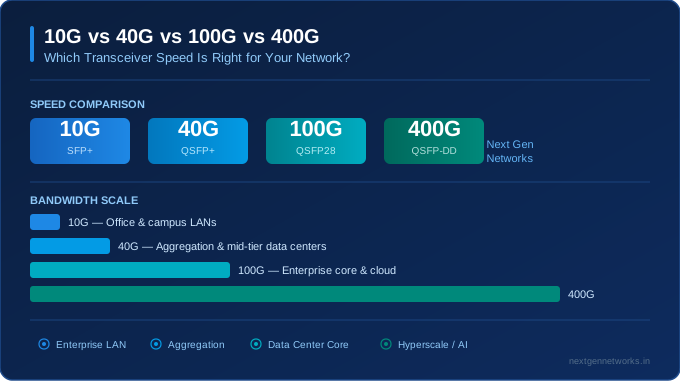
Today, four speeds dominate the market: 10G, 40G, 100G, and 400G. Each one suits a different type of network environment — from a small office to a hyperscale data center. Picking the wrong speed means either overspending on capacity you don’t need or creating a bottleneck that slows everything down.
This guide breaks down each transceiver speed in plain language, shows you exactly where each one fits, and helps you make the right call. If you’re new to transceivers, start with our overview of optical transceiver modules and form factors before diving in.
Overview of Transceiver Speeds
10G Transceivers
10 Gigabit transceivers have been the backbone of enterprise networks for over a decade. They’re mature, affordable, and widely compatible with most switches and routers. Most SFP+ modules run at 10G and support both fiber and copper connections.
- Best for: Office LANs, campus networks, access-layer switches
- Common form factors: SFP+, XFP
- Typical reach: Up to 80 km on single-mode fiber
- Cost: Lowest in the group — highly cost-effective for moderate traffic
40G Transceivers
40G transceivers emerged as the first generation of high-density data center optics. They use QSFP+ modules and are still common in mid-tier data centers and aggregation layers. Many networks use 40G as a stepping stone between 10G and 100G.
- Best for: Aggregation switches, mid-size data centers, ISP backbones
- Common form factors: QSFP+, CFP
- Typical reach: Up to 40 km on single-mode fiber
- Cost: Moderate — good balance of price and performance
100G Transceivers
The 100G transceiver module is now the standard for modern data centers. It’s the most widely deployed high-speed optic in the world, supported by nearly every major switch vendor including Cisco, Juniper, and Arista. The dominant form factor is the QSFP28, which packs 100G into the same physical shell as a QSFP+.
- Best for: Data center spine layers, cloud infrastructure, core routing
- Common form factors: QSFP28, CFP2, CFP4
- Typical reach: Up to 80 km (LR4) on single-mode fiber
- Cost: Mid-to-high — prices have dropped significantly in recent years
Understanding when to use 100G vs other speeds starts with knowing your form factor options. See our guide on SFP vs QSFP differences and use cases for a deeper comparison.
400G Transceivers
400G optics represent the next generation of high-speed transceivers. They’re designed for hyperscale data centers, AI training clusters, and ultra-high-capacity backbone networks. 400G uses newer form factors like QSFP-DD and OSFP, and it can carry four times the traffic of a 100G link in the same physical space.
- Best for: Hyperscale data centers, AI/ML infrastructure, 5G backbone
- Common form factors: QSFP-DD, OSFP, CFP8
- Typical reach: Up to 10 km on single-mode fiber (ER4)
- Cost: Higher — but rapidly falling as adoption grows
Detailed Comparison: 10G vs 40G vs 100G vs 400G Transceivers
Feature | 10G | 40G | 100G | 400G |
Speed | 10 Gbps | 40 Gbps | 100 Gbps | 400 Gbps |
Form Factor | SFP+ | QSFP+ | QSFP28 | QSFP-DD / OSFP |
Typical Cost | Lowest | Low–Mid | Mid | High (falling) |
Power (typical) | ~1W | ~3.5W | ~3.5W | ~10–15W |
Port Density | High | Medium | High | Very High |
Latency | Very Low | Low | Low | Very Low |
Scalability | Limited | Moderate | High | Very High |
Compatibility | Universal | Wide | Wide | Growing |
Best Use | Enterprise LAN | Aggregation | Data Center Core | Hyperscale / AI |
Focus: 40G vs 100G Transceiver — Key Differences
This is the most common upgrade decision in modern networking. Both 40G and 100G use QSFP-style modules and target data center environments, but they serve different stages of network maturity.
Key Differences
- Speed: 100G delivers 2.5x more throughput than 40G in the same form factor
- Cost per Gbps: 100G is now cheaper per gigabit than 40G — making it the smarter investment
- Switch support: Most modern data center switches only offer 100G ports, making 40G increasingly hard to source
- Power efficiency: 100G moves more data for only marginally more power than 40G
- Future readiness: 100G infrastructure can be upgraded to 400G with fewer changes than 40G
When Should You Upgrade from 40G to 100G? Upgrade when your spine or aggregation links run above 60% utilization consistently, when you’re deploying new switches that no longer support QSFP+, or when you’re planning for 400G within the next 3 years. The cost difference between 40G and 100G is now small enough that new deployments should default to 100G. |
Focus: 100G Transceiver Module
Types of 100G Transceivers
The 100G market has several module variants, each designed for different distances and environments:
- QSFP28 SR4: Short-range (up to 100 m) over multimode fiber — common in top-of-rack connections
- QSFP28 LR4: Long-range (up to 10 km) over single-mode fiber — used in campus and metro networks
- QSFP28 ER4: Extended range (up to 40 km) — used for WAN and backbone links
- QSFP28 CWDM4: Up to 2 km on single-mode — popular in hyperscale environments
- CFP2/CFP4: Older, larger form factors — still used in telecom and legacy systems
Common Applications
- Data center spine-leaf fabric — interconnecting top-of-rack switches to aggregation
- Cloud provider backbone — carrying massive traffic between availability zones
- Enterprise core switching — supporting 10G and 25G access layer uplinks
- 5G fronthaul and midhaul — connecting radio units to central processing
For enterprises sourcing 100G modules across multiple vendors, see our OEM vs compatible transceiver guide to understand how to balance cost and compatibility.
Focus: 400G Optics Transceivers
Technology Overview
400G transceivers use two main innovations to reach their speed: higher baud rates per lane and more lanes per module. Most 400G modules use 8 lanes running at 50G each (PAM4 modulation) to hit 400 Gbps total. This is different from 100G, which typically uses 4 lanes at 25G each.
The dominant 400G form factors are:
- QSFP-DD (Double Density): Same width as QSFP28, but with 8 electrical lanes instead of 4 — backward compatible with QSFP28 ports on many switches
- OSFP (Octal SFP): Slightly wider than QSFP-DD, allows better thermal management for higher-power modules
- CFP8: Larger form factor used in telecom and long-haul 400G deployments
Future Trends
400G adoption is accelerating fast, driven by three forces:
- AI and machine learning workloads: Training large AI models requires massive, low-latency bandwidth between GPU clusters — 400G is becoming the default interconnect
- Hyperscale data center expansion: Companies like Amazon, Google, and Microsoft are deploying 400G at scale in new builds
- 800G on the horizon: The industry is already standardizing 800G modules, which means 400G will become the new baseline within 3–5 years
If you’re building new data center infrastructure today, designing for 400G readiness — even if you deploy 100G now — is the right long-term strategy.
Choosing the Right Transceiver Speed
By Business Size
- SMB (Small & Medium Business): 10G is sufficient for most office and campus deployments. Run 10G on access switches with 40G or 100G uplinks to your core.
- Enterprise: 100G for spine and aggregation. 25G for server-to-switch connections. Plan for 400G at the core within 3–5 years.
- Hyperscale / Cloud Data Centers: 400G for spine fabric. 100G for server-to-switch. Consider 800G planning for new builds starting in 2026 and beyond.
By Workload Type
Workload | Recommended Speed | Reason |
General office traffic | 10G | Cost-efficient, sufficient bandwidth |
Streaming / media delivery | 40G–100G | High throughput needed |
Cloud applications | 100G | Low latency, high concurrency |
AI / ML training clusters | 400G | Massive east-west bandwidth |
5G infrastructure | 100G–400G | Depends on layer (front/midhaul) |
Video conferencing at scale | 40G–100G | Burst-heavy traffic patterns |
Data Center Bandwidth Considerations
Plan for 3x Your Current Peak Traffic
A common mistake in data center design is provisioning for today’s traffic, not tomorrow’s. Network traffic in enterprise environments typically grows 30–50% per year. If your spine links are running at 50% today, they’ll be at full capacity within 18 months.
The most cost-effective approach is to deploy one speed level above your current need. If you’re running 40G today, plan your next refresh around 100G. If you’re at 100G, design your new pods around 400G.
Breakout Configurations Save Money
One powerful feature of QSFP-based transceivers is breakout. A single 100G QSFP28 port can be split into four 25G connections using a breakout cable. A 400G QSFP-DD port can serve as four 100G connections. This lets you maximize expensive switch ports without buying additional hardware.
Compatibility with Your Existing Infrastructure
Before purchasing, verify that your target modules are compatible with your switch vendor. Cisco, Juniper, and Arista each have their own certification process for third-party optics. Compatible (non-OEM) modules can save 40–70% on hardware costs while delivering the same performance — but only if they’re properly validated for your platform.
For a full breakdown of how to validate compatibility before you buy, read our optical transceiver compatibility guide for Cisco, Juniper, and Arista.
Conclusion: Which Speed Is Right for You?
If you’re building or refreshing a network today, 100G is the default right answer for most enterprise and data center environments. It’s well-supported, cost-competitive, and gives you room to grow. 400G is the choice if your workloads are AI-driven, your traffic is measured in terabits, or you’re planning infrastructure that will run for the next 5–7 years.
Don’t build for today. Build for where your network needs to be in three years — because the cost of upgrading later always exceeds the cost of doing it right the first time.
Need help sourcing the right transceiver modules for your network? — we supply SFP, QSFP28, and 400G modules with full compatibility validation for Cisco, Juniper, Arista, and more.