



What is an Optical Transceiver? (Quick Overview)
Optical transceivers are compact plug-in modules (such as SFP, SFP+, and QSFP) used in networking equipment to transmit data over fiber optic cables. They convert electrical signals into light, enabling high-speed communication between switches, routers, and data centers.
As networks scale, one issue becomes unavoidable: cost. Networking vendors often price their optics at a premium, creating a dependency on their ecosystem. This leads to what’s known as vendor lock-in—where businesses are forced to buy only from a single manufacturer.
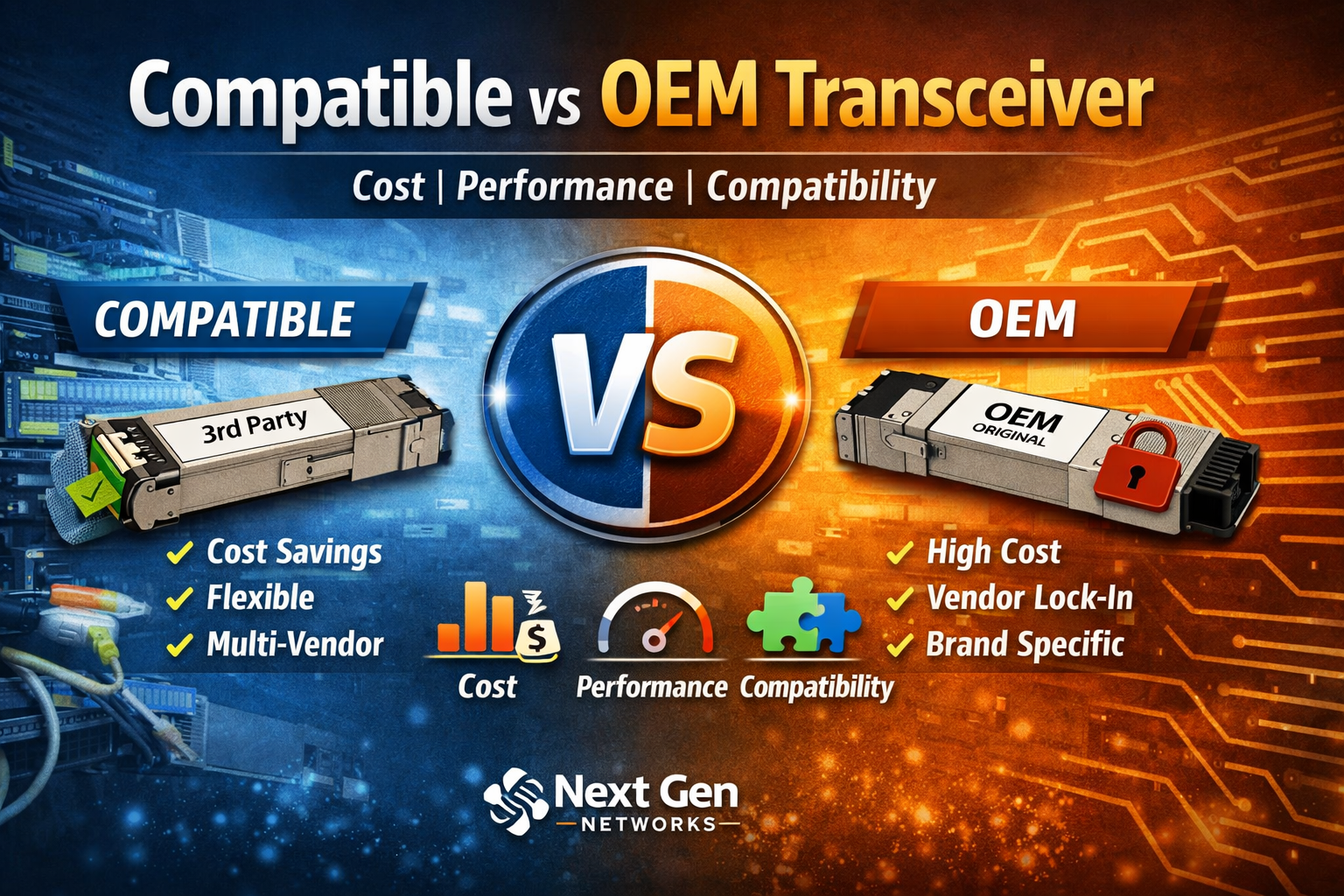
This is where the debate around compatible vs OEM transceiver becomes critical. Should you stick with official vendor modules, or switch to cost-effective third-party alternatives?
At Next Gen Networks, we help businesses make this decision based on real-world performance, cost efficiency, and long-term scalability—not marketing claims.
What is an OEM Transceiver? (Pros, Cons & Use Cases)
An OEM (Original Equipment Manufacturer) transceiver is a module produced or branded by the same company that manufactures your networking hardware, such as Cisco, Juniper, or HPE.
These modules are designed specifically for the vendor’s equipment and are sold under their brand.
Advantages of OEM Transceivers:
- Guaranteed compatibility with the hardware
- Full access to vendor support and service agreements
- No risk of hardware rejection or warning messages
Limitations of OEM Transceivers:
- Significantly higher cost compared to alternatives
- Strong vendor lock-in
- Limited flexibility in mixed-vendor environments
OEM optics are often chosen for peace of mind—but that confidence comes at a premium price.
What are Compatible / Third-Party Optical Modules?
Compatible transceivers, also known as third party optical modules, are manufactured by independent suppliers. They are engineered to meet the same technical specifications as OEM modules.
These modules are programmed and tested to work with major networking platforms.
Example: A Cisco compatible transceiver is coded to be recognized and accepted by Cisco devices.
Key Benefits of Third-Party Opitcal Modules
- Cost savings of 30% to 80%
- Flexibility across multiple vendors
- Faster availability and supply
Considerations of Third-Party Opitcal Modules
- Quality depends on the supplier
- Compatibility must be verified
At Next Gen Networks, we ensure that all compatible modules are rigorously tested for performance and interoperability before deployment.
Compatible vs OEM Transceiver: Key Differences
Feature | OEM Transceiver | Compatible Transceiver |
Price | Premium pricing | Cost-effective |
Performance | Guaranteed | Equivalent (if tested) |
Compatibility | Native support | High (pre-coded modules) |
Warranty | Limited | Often extended or lifetime |
Vendor Lock-in | High | Minimal |
Availability | Vendor-dependent | Widely available |
OEM vs Compatible Optics Cost Comparison
Cost is the most decisive factor in the compatible vs OEM transceiver discussion.
Typical Pricing:
- OEM 10G module: ₹15,000 – ₹40,000
- Compatible module: ₹2,000 – ₹8,000
This represents 30% to 80% savings per unit.
Impact at Scale:
For enterprises deploying large networks:
- 100 modules → Save up to ₹15 lakhs
- 500 modules → Save up to ₹75 lakhs
- 1000+ modules → Savings reach crores
The financial difference becomes even more significant with higher-speed optics (100G, 400G), where OEM pricing increases sharply.
At Next Gen Networks, we often see organizations reduce their optical hardware budget by more than half without sacrificing performance.
Performance Comparison: Do Compatible Transceivers Match OEM?
common misconception is that OEM optics offer better performance than compatible ones.
In reality, both types follow MSA (Multi-Source Agreement) standards. These standards define:
- Form factor (SFP, QSFP, etc.)
- Optical characteristics
- Speed and distance capabilities
What truly affects performance:
- Component quality
- Manufacturing standards
- Testing and validation
High-quality compatible modules:
- Match OEM specifications
- Undergo burn-in and stress testing
- Provide digital monitoring (DOM/DDM)
In real-world deployments, there is no noticeable performance difference when using reliable third-party optics.
Compatibility Explained: Will Third-Party Optics Work?
Compatibility is one of the most misunderstood aspects of optical transceivers.
How it Works:
Each module contains an EEPROM chip that stores vendor-specific information.
- OEM modules → Native coding
- Compatible modules → Programmed to replicate OEM coding
This allows third-party modules to be recognized as valid by the switch.
Example:
A Cisco-compatible module includes Cisco-specific identifiers, ensuring seamless operation.
Potential Risks:
- Incorrect coding
- Firmware updates blocking modules
- Low-quality suppliers
How To Avoid Issues:
- Choose reputable vendors
- Verify compatibility lists
- Request testing reports
At Next Gen Networks, every module is pre-coded and tested against target platforms to ensure plug-and-play performance.
Understanding Vendor Lock-In in Networking Hardware
Vendor lock-in networking refers to the practice of restricting users to a single vendor’s hardware ecosystem.
Why Vendors Enforce It:
- Protect revenue streams
- Maintain control over the ecosystem
- Increase long-term customer dependency
Challenges for Businesses:
- Higher operational costs
- Limited supplier options
- Reduced flexibility in scaling
How Compatible Modules Help:
- Break vendor dependency
- Enable multi-vendor strategies
- Reduce long-term costs
This flexibility is especially important for growing enterprises and data centers.
OEM vs Compatible Transceiver: Which Should You Choose?
Choose OEM Transceivers When:
- Operating mission-critical core networks
- Vendor contracts require OEM components
- Immediate vendor support is essential
Choose Compatible Transceivers When:
- Scaling infrastructure
- Optimizing costs
- Managing multi-vendor environments
- Deploying in access or edge networks
Best Approach:
Most organizations today adopt a hybrid strategy:
- OEM for critical core systems
- Compatible for large-scale deployments
This balances reliability with cost efficiency.
Final Verdict: Are Compatible Transceivers Worth It?
The compatible vs OEM transceiver decision is no longer about performance—it’s about strategy.
OEM optics provide:
- Guaranteed support
- Vendor assurance
Compatible optics provide:
- Significant cost savings
- Flexibility
- Scalability
With proper testing and supplier selection, compatible transceivers deliver the same performance at a fraction of the cost.
Recommendation from Next Gen Networks:
If your goal is to build a scalable, future-ready network, compatible transceivers are the smarter investment. Use OEM where necessary—but don’t overpay where you don’t have to.