



SFP vs QSFP: What’s the Difference and Why It Matters
Transceivers are essential networking components that enable data transfer between devices such as switches, routers, and servers. They convert electrical signals into optical signals, allowing data to travel over fiber or copper cables.
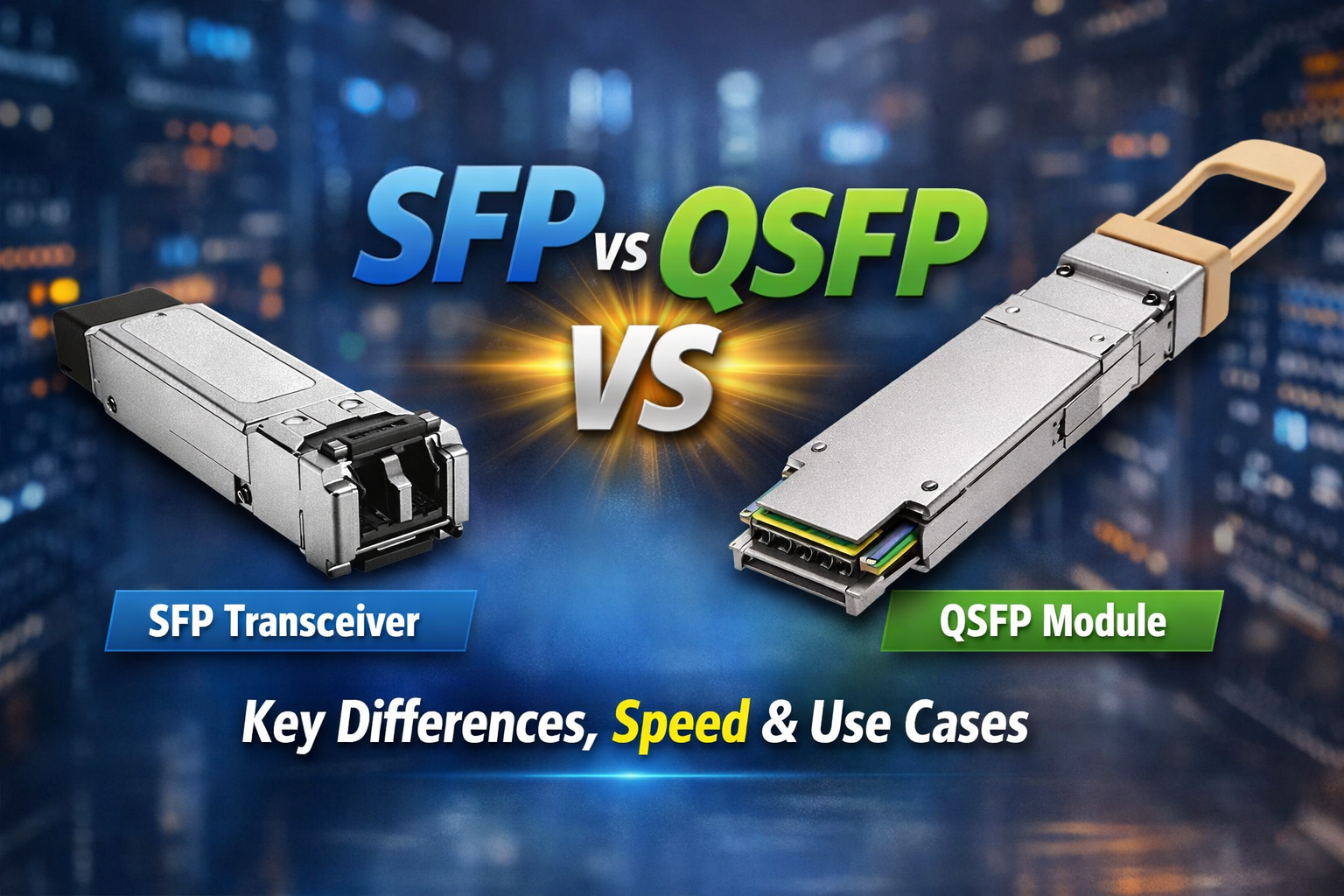
When comparing SFP vs QSFP, the key differences lie in speed, scalability, and design. While both are widely used network modules, they serve different roles in modern infrastructure. Choosing the right one can directly impact your network performance, cost efficiency, and future scalability.
What is an SFP Transceiver? Features, Speed & Use Cases
An SFP transceiver (Small Form-factor Pluggable) is a compact, hot-swappable module used in networking and telecom equipment.
Key Features
- Single-lane data transmission
- Supports fiber and copper connections
- Hot-swappable for easy maintenance
Speed Range
SFP modules support a range of speeds:
- 1 Gbps (SFP) – common in legacy systems
- 10 Gbps (SFP+) – widely used in enterprise networks
- 25 Gbps (SFP28) – used in modern high-speed setups
Common Use Cases
SFP transceivers are typically used in:
- Enterprise LAN networks
- Access layer switches
- Campus networks
- Small to mid-sized data centers
Why Choose SFP?
- Lower cost per module
- Simple deployment
- Sufficient for moderate bandwidth needs
What is a QSFP Module? Architecture, Speed & Applications
A QSFP module (Quad Small Form-factor Pluggable) is designed for high-speed data transmission in advanced networking environments.
Key Features
- Multi-lane architecture (usually 4 lanes)
- Higher aggregate bandwidth
- Supports breakout configurations
Multi-Lane Structure Explained
The main difference between SFP and QSFP is architecture.
- SFP uses 1 lane
- QSFP uses 4 parallel lanes
This allows QSFP to carry multiple data streams simultaneously.
Example:
- QSFP+ → 4 × 10G = 40 Gbps
- QSFP28 → 4 × 25G = 100 Gbps
Speed Range
QSFP modules support:
- 40 Gbps (QSFP+)
- 100 Gbps (QSFP28)
- 200 Gbps / 400 Gbps (QSFP56, QSFP-DD)
Typical Applications
- Data center spine-leaf architecture
- Cloud infrastructure
- High-speed aggregation layers
- Core network backbones
SFP vs QSFP: Key Differences Explained (Quick Comparison Table)
Understanding the difference between SFP and QSFP is easier with a direct comparison:
Feature | SFP Transceiver | QSFP Module |
|---|---|---|
Speed | 1G, 10G, 25G | 40G, 100G, 200G, 400G |
Form Factor | Smaller | Slightly larger |
Channels | 1 lane | 4 lanes (or more in newer versions) |
Bandwidth | Lower aggregate | High aggregate |
Port Density | Lower | Higher |
Cost | Lower upfront | Higher upfront |
Power Usage | Lower | Higher |
Use Cases | Access & enterprise networks | Data centers & core networks |
Key Insight
QSFP achieves higher throughput by using parallel data lanes, while SFP relies on a single channel. This makes QSFP more efficient for high-bandwidth environments.
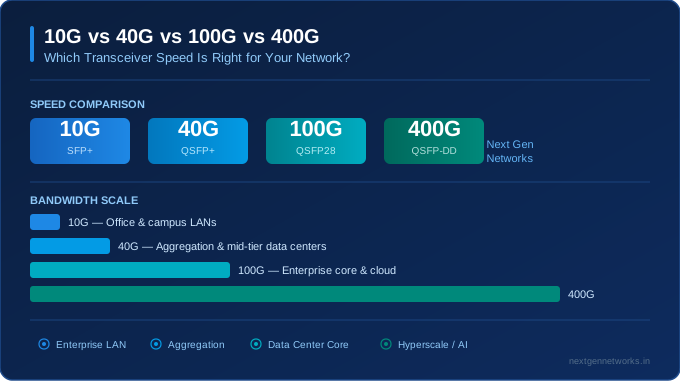
SFP vs QSFP Speed Comparison: 1G vs 10G vs 40G vs 100G
Speed is often the deciding factor in a network module comparison.
SFP Speed Breakdown
- 1G → legacy deployments
- 10G → standard enterprise use
- 25G → modern access and server connectivity
QSFP Speed Breakdown
- 40G → early data center standard
- 100G → current mainstream
- 200G / 400G → next-generation infrastructure
Real-World Comparison
To achieve 40G:
- Using SFP+ → Requires 4 ports and 4 modules
- Using QSFP+ → Requires 1 port and 1 module
Practical Impact
- Fewer ports required
- Reduced cabling complexity
- Better switch utilization
- Easier scalability
This is why QSFP dominates in high-density environments like data centers.
SFP vs QSFP Use Cases: When to Use Each in Real Networks
Choosing between SFP vs QSFP depends on your network size, speed requirements, and budget.
When to Use SFP Transceivers
Use SFP when:
- Bandwidth needs are 1G–25G
- Network size is small to medium
- Budget is limited
- Simplicity is a priority
Examples:
- Office network infrastructure
- Campus connectivity
- ISP edge networks
When to Use QSFP Modules
Use QSFP when:
- High bandwidth (40G+) is required
- You need high port density
- Network traffic is heavy or growing
- Future scalability is important
Examples:
- Data center spine-leaf architecture
- High-performance computing environments
- Cloud and hyperscale networks
How to Choose Between SFP and QSFP (Buyer’s Guide)
Selecting the right module involves balancing performance, cost, and future growth.
- Bandwidth Needs
- Up to 25G → SFP is sufficient
- 40G and above → QSFP is required
- Network Scale
- Small or static networks → SFP
- Large or expanding networks → QSFP
- Budget vs ROI
- SFP → Lower upfront cost
- QSFP → Higher upfront cost, but better long-term efficiency
- Port Density
QSFP reduces the number of required ports, which:
- Saves switch space
- Lowers infrastructure complexity
- Future-Proofing
QSFP supports higher speeds like 100G, 200G, and 400G, making it a better long-term investment.
Quick Decision Guide
- Choose SFP for cost-efficient, lower-speed networks
Choose QSFP for high-speed, scalable infrastructure
SFP vs QSFP: Which One Should You Choose?
The SFP vs QSFP comparison highlights a clear trade-off between simplicity and performance.
- SFP transceivers are ideal for cost-sensitive, lower-speed applications
- QSFP modules are built for high-speed, high-density, and future-ready networks
If your network is stable and bandwidth needs are moderate, SFP is a practical choice.
However, for growing networks and data-intensive environments, QSFP delivers better scalability and long-term value.
Understanding this difference between SFP and QSFP ensures you choose the right solution for both current needs and future expansion.