



As network speeds continue to increase, businesses and data centers need optical modules that can support reliable, high-speed connectivity. Fortinet offers different FN-TRAN QSFP56 and QSFP-DD modules for network environments that require fast and efficient fiber connections. For suppliers and IT teams, understanding the differences between these modules can make purchasing and deployment easier.
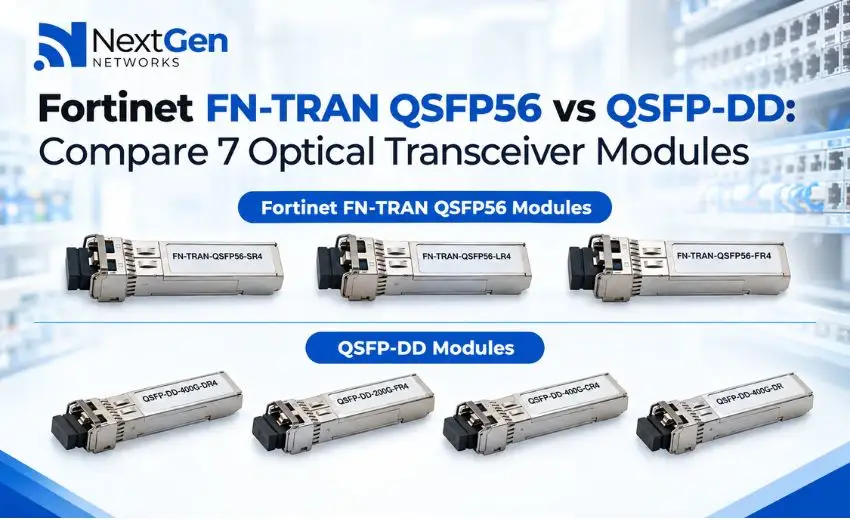
This guide compares seven FN-TRAN modules and explains their basic applications, making it easier to identify the right Fortinet Optical transceiver for different network requirements.
1. FN-TRAN-QSFP56-SR4
The FN-TRAN-QSFP56-SR4 is designed for short-distance, high-speed fiber connectivity. It is a suitable option for data center environments where switches and other network devices are located within a relatively short distance.
For network suppliers, this module can be useful when customers need high-speed connections for server-to-switch or switch-to-switch deployments over multimode fiber.
2. FN-TRAN-QSFP56-FR4
The FN-TRAN-QSFP56-FR4 provides a longer reach compared with short-range solutions. It is designed for applications where network devices need to be connected over greater distances while maintaining high-speed optical connectivity.
This makes it a useful Fortinet Optical transceiver option for enterprise networks and data center connections that require more reach than typical short-range deployments.
3. FN-TRAN-QSFPDD-SR8
The FN-TRAN-QSFPDD-SR8 is a QSFP-DD-based module intended for high-density network environments. SR8 modules are generally used for short-distance optical connections.
For suppliers handling data center projects, this type of module can be considered when customers need high-speed connectivity in a compact form factor.
4. FN-TRAN-QSFPDD-DR4
The FN-TRAN-QSFPDD-DR4 is designed for longer-reach data center connectivity than short-range modules. It can be useful for connecting network equipment across different areas of a data center.
When selecting a Fortinet Optical transceiver, buyers should consider factors such as required distance, fiber type, network speed, and equipment compatibility.
5. FN-TRAN-QSFPDD-DR4+
The FN-TRAN-QSFPDD-DR4+ is another option for high-speed optical networking where additional reach may be required. It is particularly relevant for network projects that need higher-performance connectivity while maintaining a compact QSFP-DD form factor.
Network suppliers can include this module when offering customers different connectivity options for modern data center infrastructure.
6. FN-TRAN-QSFPDD-FR4
The FN-TRAN-QSFPDD-FR4 is designed for applications requiring a balance between high-speed connectivity and optical reach. It can be considered for data center and enterprise networking environments where devices are not located immediately next to each other.
For procurement teams, comparing FR4 with SR4 and DR4 options can help identify the module that best matches the required deployment distance.
7. FN-TRAN-QSFPDD-LR4
The FN-TRAN-QSFPDD-LR4 is intended for longer-distance optical connectivity. It can be useful for network environments where connections need to cover greater distances than SR or FR solutions.
For suppliers supporting large enterprise or data center deployments, LR4 can be an important option when longer optical reach is part of the project requirement.
QSFP56 vs QSFP-DD: What Is the Difference?
The main difference between QSFP56 and QSFP-DD is the module architecture and the type of high-speed networking applications they support. QSFP-DD was developed to provide greater bandwidth and high-density connectivity while retaining a compact QSFP-style form factor.
The right choice depends on the customer’s equipment, required network speed, fiber infrastructure, transmission distance, and port compatibility. Therefore, buyers should always verify the supported module specifications before placing an order.
Choosing the Right Fortinet FN-TRAN Module
For network suppliers, there is no single module that fits every project. Short-range modules such as SR4 and SR8 can be suitable for shorter connections, while FR4, DR4, DR4+, and LR4 options can be considered when greater reach is required.
Before purchasing a Fortinet Optical transceiver, suppliers should check the network equipment compatibility, required transmission distance, fiber type, connector requirements, and deployment environment.
Buy Fortinet FN-TRAN Optical Transceivers from NextGen Networks
Choosing the right optical module is important for reliable network deployment and smooth connectivity. The seven FN-TRAN QSFP56 and QSFP-DD modules discussed above provide different options for short-, medium-, and longer-distance networking requirements.
NextGen Networks helps businesses, IT teams, and network suppliers source optical networking products for their infrastructure projects. For bulk requirements or specific FN-TRAN module needs, buyers can contact NextGen Networks to discuss the right option for their network deployment.