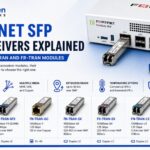




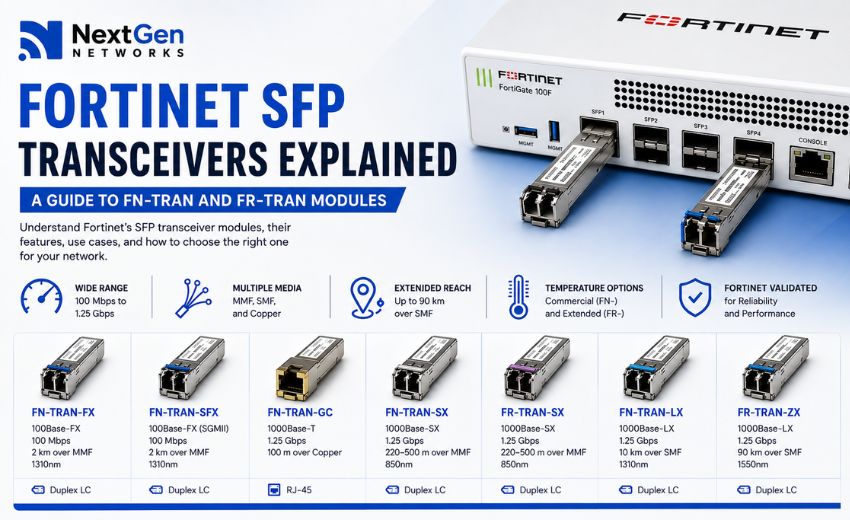
If you manage FortiGate firewalls or FortiSwitch switches, you’ve probably run into Fortinet’s transceiver naming system — a string of letters and numbers that isn’t always self-explanatory. FN-TRAN-FX, FR-TRAN-SX, FN-TRAN-GC: each one plugs into an SFP slot, but they’re built for different fiber types, distances, and operating conditions. This guide walks through seven commonly ordered modules, what each one actually does, and how Fortinet’s naming convention works, so you can order the right part the first time.
Understanding Fortinet’s Transceiver Naming Convention
Before getting into individual modules, it helps to know what the prefixes mean. Fortinet transceivers generally use an FN- prefix for its standard commercial-temperature-range modules and an FR- prefix for extended (industrial) temperature-range variants of the same underlying optics — you’ll see this directly with FN-TRAN-SX and FR-TRAN-SX, which share the same 1000BASE-SX standard, reach, and wavelength but are rated for different operating temperature ranges. All seven modules covered here are SFP form factor, hot-swappable, MSA-compliant, and include a serial ID PROM for auto-detection on Fortinet hardware.
FN-TRAN-FX
The FN-TRAN-FX is a 100 Mbps SFP module built to the 100Base-FX standard (IEEE 802.3u). It runs over multimode fiber at 1310nm, terminated with a duplex LC connector, and supports 10/100 Mb mode selection.
Reach: 2 km over MMF
Operating temperature: -40°C to 85°C
Power draw: Under 1.1W
Typical use: Legacy 100 Mbps fiber uplinks — branch office equipment, older switch aggregation links, or any environment still running Fast Ethernet over fiber rather than copper.
FN-TRAN-SFX
The FN-TRAN-SFX covers the same ground as the FN-TRAN-FX — 100Base-FX, 2 km over multimode fiber, 1310nm, duplex LC — but with an SGMII electrical interface instead of the standard interface. SGMII is used by certain FortiGate and FortiSwitch platforms that expect this interface at the SFP cage.
Reach: 2 km over MMF
Operating temperature: -40°C to 85°C
Power draw: Under 1.2W
Typical use: The same 100 Mbps fiber applications as the FN-TRAN-FX, but specifically for platforms that require an SGMII-interface module. Check your device’s transceiver compatibility table before choosing between the two — they aren’t interchangeable if your hardware expects one interface type specifically.
FN-TRAN-GC
The FN-TRAN-GC is a 1000BASE-T copper SFP module — the only one in this group that isn’t fiber. It delivers 1.25 Gbps Ethernet over standard copper cabling through an RJ-45 connector, letting you add a Gigabit copper port to an SFP slot originally designed for fiber optics.
Reach: 100 meters over copper
Operating temperature: -40°C to 85°C
Power draw: 1.05W
Typical use: Adding a copper Gigabit uplink to a switch or firewall that only has SFP cages, without needing a separate copper port or media converter. Note that unlike the fiber modules in this group, the FN-TRAN-GC does not support digital diagnostic monitoring.
FN-TRAN-SX and FR-TRAN-SX
These two modules are functionally the same optics: both are 1000BASE-SX (IEEE 802.3z) SFPs running at 850nm over multimode fiber with a duplex LC connector, supporting 220 meters on legacy 62.5/125µm fiber or up to 500 meters on 50/125µm fiber. The difference is operating temperature range.
FN-TRAN-SX: -20°C to 85°C, under 800mW
FR-TRAN-SX: -40°C to 85°C, under 500mW
Typical use: Standard Gigabit multimode fiber links within a building or between nearby wiring closets. Choose the FR-TRAN-SX over the FN-TRAN-SX if the installation site — an outdoor cabinet, unconditioned equipment room, or similar — needs the wider industrial temperature tolerance.
FN-TRAN-LX
The FN-TRAN-LX is a 1000BASE-LX (IEEE 802.3z) SFP for longer single-mode fiber runs, operating at 1310nm over a duplex LC connection.
Reach: 10 km over SMF
Operating temperature: -40°C to 85°C
Power draw: Under 830mW
Typical use: Connecting Gigabit links between buildings on a campus, or any point-to-point single-mode run beyond what multimode SX optics can cover.
FR-TRAN-ZX
The FR-TRAN-ZX is the long-haul option in this group — a 1000BASE-LX-class SFP tuned for extended single-mode reach at 1550nm.
Reach: 90 km over SMF
Operating temperature: -40°C to 85°C
Power draw: Under 700mW
Typical use: Metro-scale or inter-site Gigabit links where 10 km isn’t nearly enough — connecting facilities across a city or a wide campus footprint on dedicated dark fiber.
Quick Reference
| Model | Standard | Speed | Media | Wavelength | Max Reach | Connector | Temp Range |
| FN-TRAN-FX | 100Base-FX | 100 Mbps | MMF | 1310nm | 2 km | Duplex LC | -40°C to 85°C |
| FN-TRAN-SFX | 100Base-FX (SGMII) | 100 Mbps | MMF | 1310nm | 2 km | Duplex LC | -40°C to 85°C |
| FN-TRAN-GC | 1000Base-T | 1.25 Gbps | Copper | — | 100 m | RJ-45 | -40°C to 85°C |
| FN-TRAN-SX | 1000Base-SX | 1.25 Gbps | MMF | 850nm | 220–500 m | Duplex LC | -20°C to 85°C |
| FR-TRAN-SX | 1000Base-SX | 1.25 Gbps | MMF | 850nm | 220–500 m | Duplex LC | -40°C to 85°C |
| FN-TRAN-LX | 1000Base-LX | 1.25 Gbps | SMF | 1310nm | 10 km | Duplex LC | -40°C to 85°C |
| FR-TRAN-ZX | 1000Base-LX | 1.25 Gbps | SMF | 1550nm | 90 km | Duplex LC | -40°C to 85°C |
Practical Buying Guidance
Match the module to the port, not just the speed.
All seven of these are 1.25 Gbps-class SFP or 100 Mbps modules — they physically fit the same SFP cage, but your FortiGate or FortiSwitch model has a specific supported-transceiver list. Check that list before ordering, since not every platform supports every module (older shared-media ports, for instance, may not support all interface types).
Fiber type decides more than distance does.
If your building already has multimode fiber runs, FN-TRAN-SX or FR-TRAN-SX get you Gigabit connectivity without pulling new cabling. If you’re running single-mode fiber, or the link needs to go beyond 500 meters, you’re choosing between FN-TRAN-LX (10 km) and FR-TRAN-ZX (90 km) — don’t over-buy reach you won’t use, since longer-reach optics typically cost more.
Watch the operating temperature spec on outdoor or unconditioned installs.
The FN- and FR- prefix difference on the SX modules exists specifically for this reason — if the transceiver will sit in an outdoor cabinet or an equipment room without climate control, the wider -40°C to 85°C rating on the FR-TRAN-SX is the safer choice over the standard FN-TRAN-SX.
Confirm interface type on 100 Mbps links.
The FN-TRAN-FX and FN-TRAN-SFX look identical on a spec sheet but use different electrical interfaces (standard vs. SGMII). Ordering the wrong one for your platform is a common, avoidable mistake — check your device’s compatibility table first.
Sourcing Genuine Fortinet Transceivers
Fortinet appliances validate transceivers against a coded compatibility list, so using genuine or properly Fortinet-coded modules avoids the port errors and support headaches that come with mismatched or uncoded optics. NextGen Networks carries Fortinet transceiver modules across this range and can help confirm which part matches your specific FortiGate or FortiSwitch model before you order.
Frequently Asked Questions
What’s the difference between FN-TRAN-SX and FR-TRAN-SX?
They’re the same 1000BASE-SX optical specification — same speed, reach, and wavelength — but the FR-TRAN-SX is rated for a wider -40°C to 85°C operating temperature range, versus -20°C to 85°C on the FN-TRAN-SX.
Can I use FN-TRAN-FX and FN-TRAN-SFX interchangeably?
Not necessarily. Both are 100Base-FX modules with the same reach and wavelength, but the FN-TRAN-SFX uses an SGMII electrical interface rather than the standard interface used by the FN-TRAN-FX. Check your platform’s requirement before substituting one for the other.
Does FN-TRAN-GC support digital diagnostics?
No. Unlike the fiber modules in Fortinet’s SFP lineup, the FN-TRAN-GC copper module does not support digital optical/diagnostic monitoring.
What’s the maximum distance for FR-TRAN-ZX?
Up to 90 km over single-mode fiber at 1550nm, making it the longest-reach module in Fortinet’s standard 1G SFP lineup.
Do I need Fortinet-branded transceivers, or will compatible modules work?
FortiGate and FortiSwitch devices check transceivers against a coded compatibility list. Genuine Fortinet modules are guaranteed to pass that check; third-party “compatible” modules may work if properly coded, but compatibility should be confirmed against your specific hardware model before purchase.
What fiber type does FN-TRAN-LX use?
Single-mode fiber (SMF), operating at 1310nm with a duplex LC connector, reaching up to 10 km.
Conclusion
Fortinet’s SFP lineup covers a wide spread of needs from a handful of part numbers: FN-TRAN-FX and FN-TRAN-SFX for legacy 100 Mbps fiber links, FN-TRAN-GC for copper Gigabit over an SFP cage, FN-TRAN-SX and FR-TRAN-SX for standard and extended-temperature multimode Gigabit, and FN-TRAN-LX and FR-TRAN-ZX for single-mode reach up to 10 km and 90 km respectively. Once you know what the FN-/FR- prefixes and standard names actually mean, picking the right module comes down to matching fiber type, reach, and temperature range to your installation. NextGen Networks stocks the full Fortinet transceiver range if you need help confirming the right part for your FortiGate or FortiSwitch deployment.