



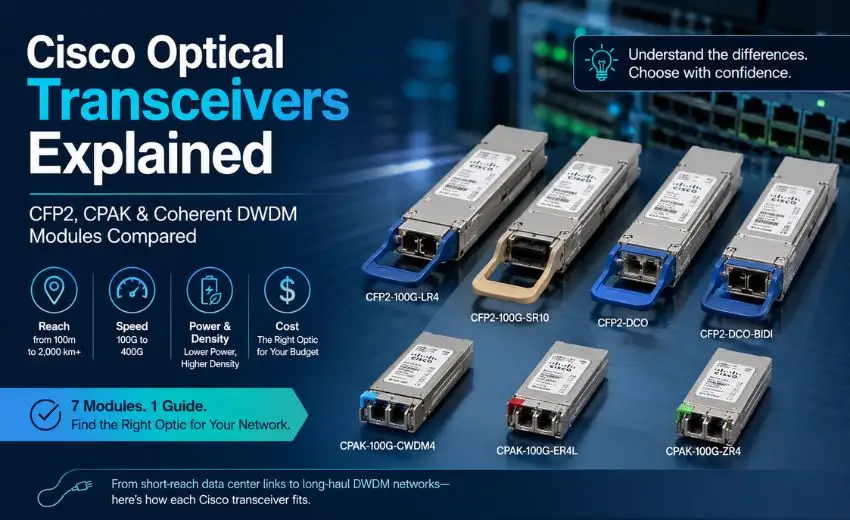
Cisco’s optics portfolio can be confusing even for people who work with it regularly. Between CFP2, CPAK, and coherent CFP2-DCO modules, there are several ways to get 100G or 400G onto a fiber link — and each one trades off reach, power draw, and cost differently. If you’ve been asked to source or replace Cisco Optical Transceivers such as the Cisco CFP2-100G-LR4, CPAK-100G-CWDM4, or CFP2-DCO-BIDI and want to understand what you’re actually buying before you order, this guide walks through all seven modules, what separates them, and how to pick the right one.
Cisco CFP2-100G-LR4
The CFP2-100G-LR4 is a 100 Gigabit Ethernet transceiver built for standard single-mode fiber reach. It carries the 100G signal across four LAN-WDM wavelengths in the 1310nm band, multiplexed internally, and terminates on a duplex LC connector. It’s IEEE 802.3ba compliant and supports Digital Optical Monitoring (DOM) for real-time visibility into optical performance.
Reach: Up to 10 km over standard G.652 single-mode fiber.
Best for: Data center interconnects, campus core links, and service-provider aggregation where you need 100G over a relatively long single-mode run without stepping up to coherent optics.
Buying note: Because it uses four discrete wavelengths rather than a single laser, the CFP2-100G-LR4 doesn’t require FEC to hit its full 10 km reach — it’s a straightforward, no-fuss option if your platform doesn’t have FEC enabled.
Cisco CFP2-100G-SR10
The CFP2-100G-SR10 takes the opposite approach: instead of a handful of long-reach wavelengths on single-mode fiber, it spreads the 100G signal across ten parallel 10G lanes at 850nm on multimode fiber, terminated with a 24-fiber MPO/MTP connector.
Reach: 100 meters on OM3 multimode fiber, 150 meters on OM4.
Best for: High-density, short-reach links inside a single data hall — switch-to-switch or switch-to-server connections where you already have parallel multimode cabling in place. It can also be used in 10×10 Gigabit Ethernet breakout mode with the right fan-out cabling.
Buying note: Cable polarity matters here. The SR10’s MPO-24 wiring scheme is specific to this module and isn’t the same as the more common Polarity B scheme used for 40G/100G SR4 links — double-check your patch cords before deployment.
Cisco CFP2-DCO
The CFP2-DCO is Cisco’s digital coherent CFP2 pluggable — a fundamentally different technology from the LR4/SR10 modules above. Rather than direct-detect Ethernet optics, it uses DP-mQAM modulation with coherent intradyne detection and carries its own onboard DSP, meaning the module itself (not the line card) handles the coherent signal processing. That makes it usable across any platform with a CFP2 slot, not just line cards purpose-built for coherent DSP.
Modulation and reach: Software-selectable between 100G QPSK (up to roughly 2,000 km on standard SMF), and higher-order 200G/400G-class modulation schemes for shorter, higher-capacity links. Reach and capacity are a direct trade-off — higher order modulation buys more bandwidth per wavelength at the cost of distance.
Best for: Metro and long-haul DWDM transport, service-provider access aggregation, and IP-over-DWDM designs where a router or switch needs a tunable, amplified DWDM interface without a separate transponder shelf.
Buying note: Cisco licenses higher bit rates on top of a base 100G module, so confirm whether the unit you’re sourcing already includes the license tier (100G-only vs. 200G-upgradable) you need — this affects both price and day-one capability.
Cisco CFP2-DCO-BIDI
The CFP2-DCO-BIDI takes the coherent CFP2 concept and adapts it for single-fiber bidirectional transmission — sending and receiving on one strand of fiber instead of a transmit/receive pair, using a dual-laser approach to separate the two directions. Everything else about the coherent engine is shared with Cisco’s other digital coherent pluggables: it supports 100 Gbps QPSK, 200 Gbps QPSK, and 400 Gbps 16-QAM modes on a fully C-band tunable module.
Best for: Situations where fiber count is genuinely constrained — metro rings, campus links, or facilities where pulling a second fiber strand isn’t practical — but you still need coherent-grade reach and capacity.
Buying note: BiDi coherent transmission requires an external device to combine the TX and RX paths onto the single fiber at each end, so factor that into your design rather than assuming the module alone handles it.
Cisco CPAK-100G-CWDM4
The CPAK-100G-CWDM4 is a compact 100G module using four CWDM wavelengths (1271nm, 1291nm, 1311nm, and 1331nm) over standard single-mode fiber with duplex LC connectors. CPAK as a form factor is smaller and considerably lower-power than CFP2 — Cisco specs it at roughly 40% less power than CFP2 and up to 20% greater port density.
Reach: Up to 2 km over G.652 single-mode fiber.
Best for: Shorter single-mode runs — within a campus or between adjacent buildings — where CFP2-LR4’s 10 km isn’t necessary and the lower power draw and smaller footprint of CPAK make more sense for high-density line cards.
Buying note: CPAK modules are platform-specific — they’re used in Cisco ASR 1000/9000, CRS-X, NCS, and Nexus 7000/7700 line cards, not the same slot types as CFP2. Confirm your chassis actually has CPAK ports before ordering.
Cisco CPAK-100G-ER4L
The CPAK-100G-ER4L extends single-mode reach considerably further than the CWDM4 module, using the same four-wavelength LAN-WDM approach as the CFP2-LR4 but in the smaller CPAK form factor, terminated with a dual SC/PC connector.
Reach: Roughly 25 km over standard SMF without FEC.
Best for: Longer point-to-point single-mode links — metro-edge connections, data center interconnect between nearby sites, or extended campus backbones — on platforms that support CPAK rather than CFP2.
Buying note: The “L” (Lite) variant doesn’t use FEC to extend reach the way some other ER4 variants do, so 25 km is close to its practical ceiling; if your link is longer, you’ll need a different module or an amplified/engineered link design.
Cisco CPAK-100G-LR4
Sitting between the CWDM4 and ER4L in Cisco’s CPAK lineup, the CPAK-100G-LR4 is the direct CPAK equivalent of the CFP2-100G-LR4: four LAN-WDM wavelengths, 10 km reach, and IEEE 802.3ba compliance. Depending on the hardware version, it terminates on either a dual SC/PC connector (with an LC-SC adapter that can be removed on newer versions) or dual LC directly.
Reach: Up to 10 km over standard SMF.
Best for: The same use case as the CFP2-100G-LR4 — general-purpose 100G single-mode links up to 10 km — but on platforms that use the CPAK form factor and benefit from its lower power draw and higher port density.
Buying note: Check the hardware version before assuming connector type. Earlier CPAK-100G-LR4 units ship with SC connectors and an LC adapter; version 09 and later default to LC. Mismatched connector expectations are a common source of last-minute cabling headaches.
Comparison of Cisco CFP2 and CPAK Optical Transceivers
| Model | Form Factor | Fiber Type | Wavelength(s) | Max Reach | Connector |
| CFP2-100G-LR4 | CFP2 | Single-mode | 1310nm band (4x LAN-WDM) | 10 km | Duplex LC |
| CFP2-100G-SR10 | CFP2 | Multimode | 850nm (10x lanes) | 100m (OM3) / 150m (OM4) | MPO/MTP-24 |
| CFP2-DCO | CFP2 (coherent) | Single-mode DWDM | C-band tunable | Up to ~2,000 km (QPSK) | Duplex LC |
| CFP2-DCO-BIDI | CFP2 (coherent) | Single-mode DWDM, single fiber | C-band tunable | Varies by mode (100G–400G) | Duplex LC |
| CPAK-100G-CWDM4 | CPAK | Single-mode | 1271/1291/1311/1331nm | 2 km | Duplex LC |
| CPAK-100G-ER4L | CPAK | Single-mode | 1310nm band (4x LAN-WDM) | ~25 km | Dual SC/PC |
| CPAK-100G-LR4 | CPAK | Single-mode | 1310nm band (4x LAN-WDM) | 10 km | SC/PC or LC (version-dependent) |
Choosing the right Cisco Optical Transceivers depends on several factors, including the Cisco platform, fiber type, transmission distance, connector, and whether you need standard Ethernet connectivity or coherent DWDM technology. Comparing these specifications before purchasing can help avoid compatibility issues and ensure the optic matches your network requirements.
CFP2 vs. CPAK vs. CFP2-DCO: How to Choose
Start with your chassis, not the module.
CFP2 and CPAK are physically different form factors that plug into different line cards — a CPAK module won’t fit a CFP2 slot without an adapter (Cisco does offer a CFP2-to-CPAK port adapter for platforms that support it). Confirm which slot type your router, switch, or line card actually has before comparing optics.
Then match reach and fiber type to your link.
For multimode, short-reach, high-density connections, the CFP2-100G-SR10 is the clear fit. For single-mode links, distance decides it: 2 km points to CPAK-100G-CWDM4, 10 km to either the CFP2-100G-LR4 or CPAK-100G-LR4 depending on your slot type, and roughly 25 km to the CPAK-100G-ER4L.
Move to coherent optics only when you actually need DWDM.
The CFP2-DCO and CFP2-DCO-BIDI aren’t drop-in replacements for the Ethernet-class CFP2/CPAK modules above — they’re a different technology aimed at metro and long-haul DWDM transport, tunable across the C-band, with reach measured in tens or hundreds of kilometers rather than tens of kilometers. If your requirement is “get 100G from one building to another two kilometers away,” a coherent module is overkill; if you’re aggregating multiple wavelengths onto a shared DWDM system across a metro ring, it’s the right tool.
Check power and port density if you’re building high-density line cards.
CPAK’s lower power draw and smaller footprint versus CFP2 matters more as port count scales — it’s worth weighing even when both form factors could technically do the job.
Frequently Asked Questions
What’s the difference between Cisco CFP2 and CPAK transceivers?
They’re different physical form factors. CPAK is smaller, uses significantly less power, and offers higher port density than CFP2, but the two aren’t interchangeable without an adapter, and each is supported on a different set of Cisco platforms.
Does the Cisco CFP2-100G-LR4 require FEC?
No. It’s an IEEE 802.3ba-compliant module that reaches its full 10 km distance without relying on forward error correction, unlike some newer PAM4-based 100G optics.
What is a CFP2-DCO module used for?
It’s a digital coherent DWDM pluggable used for metro and long-haul optical transport — carrying a tunable wavelength across a DWDM network at 100G, 200G, or higher, rather than a fixed-wavelength point-to-point Ethernet link.
How is CFP2-DCO-BIDI different from a standard CFP2-DCO?
The BiDi variant transmits and receives on a single fiber strand instead of a transmit/receive pair, using a dual-laser design, which is useful where fiber count is limited.
What distance does the Cisco CPAK-100G-CWDM4 support?
Up to 2 km over standard single-mode fiber, using four CWDM wavelengths multiplexed onto a duplex LC connection.
Can I use a CPAK module in a CFP2 port, or vice versa?
Not directly — they’re different form factors. Cisco offers a CFP2-to-CPAK port adapter for platforms that support it, which lets a CPAK module plug into a CFP2 slot.
Is the CPAK-100G-ER4L the longest-reach CPAK option?
Among the modules covered here, yes — it reaches roughly 25 km without FEC, longer than the CWDM4 (2 km) or LR4 (10 km) CPAK variants.
Where to Source These Modules
Sourcing genuine Cisco optics matters more with this product family than most — coherent modules like the CFP2-DCO and CFP2-DCO-BIDI carry licensing tiers, and Ethernet-class modules need to match your exact platform and hardware version to avoid connector or compatibility surprises. NextGen Networks stocks Cisco CFP2, CPAK, and coherent DWDM transceivers across this range, and can help confirm which module and connector variant matches your specific chassis and line card before you order.
Conclusion
The seven Cisco Optical Transceivers covered here — CFP2-100G-LR4, CFP2-100G-SR10, CFP2-DCO, CFP2-DCO-BIDI, CPAK-100G-CWDM4, CPAK-100G-ER4L, and CPAK-100G-LR4 — cover almost every way Cisco lets you get 100G onto a link, plus a path into coherent DWDM transport when Ethernet-class optics aren’t enough. The right choice comes down to three questions: what slot does your hardware have, how far does the signal need to travel, and do you actually need coherent DWDM or just point-to-point Ethernet. Work through those in order and the rest of the decision falls into place. If you’re still weighing options, NextGen Networks can help match the right module to your platform before you commit to an order.