



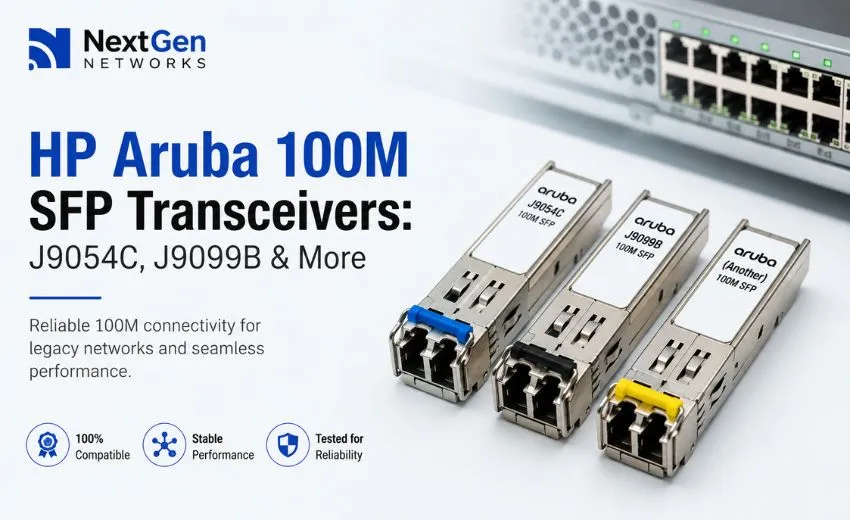
When maintaining older enterprise networks, finding the correct 100 Mbps SFP transceiver is often more complicated than simply matching the connector or fiber type. Part numbers such as J9054C, J9054D, J9099B, J9100B, JD101A, and JD120B are associated with HP, Aruba, and HPE networking platforms, but they serve different optical applications and have different compatibility requirements.
This guide explains the key specifications, fiber types, transmission distances, BiDi pairing requirements, and platform considerations for these six 100M SFP transceivers.
100M SFP Transceivers at a Glance
| Model | Product Type | Wavelength | Fiber | Maximum Distance | Connector |
| J9054C | 100BASE-FX | 1310 nm | MMF | 2 km | LC |
| J9054D | 100BASE-FX | 1310 nm | MMF | 2 km | LC |
| J9099B | 100BASE-BX10-D | 1550 nm TX / 1310 nm RX | SMF | 10 km | LC |
| J9100B | 100BASE-BX10-U | 1310 nm TX / 1550 nm RX | SMF | 10 km | LC |
| JD101A | 100BASE-BX10-D | 1550 nm TX / 1310 nm RX | SMF | 15 km | LC |
| JD120B | 100M SFP LC LX | 1310 nm | SMF | 15 km | LC |
Specifications should always be checked against the supported-transceiver documentation for the specific switch platform before deployment.
J9054C — HPE X111 100M SFP LC FX Transceiver
The J9054C is an HPE X111 100M SFP LC FX transceiver designed for 100BASE-FX connectivity over multimode fiber.
It operates at a nominal 1310 nm wavelength and supports transmission up to 2 km over multimode fiber. It uses an LC connector. Aruba’s transceiver documentation lists the J9054C as an earlier revision of the 100FX module and identifies it as End of Life (EOL), while retaining it in compatibility documentation for supported legacy platforms.
Key specifications
- Speed: 100 Mbps
- Standard: 100BASE-FX
- Wavelength: 1310 nm
- Fiber: Multimode fiber
- Reach: Up to 2 km
- Connector: LC
- Product status: EOL
For existing installations, the J9054C may still be relevant when maintaining compatible legacy hardware. However, buyers should verify the exact switch model and available replacement options before ordering.
J9054D — Aruba 100M SFP LC FX 2km MMF Transceiver
The J9054D is the Revision D version of the 100M FX transceiver. Aruba documentation states that the specifications for the Revision D product are the same as the earlier J9054 revisions.
The module supports 100BASE-FX, operates at 1310 nm, and provides up to 2 km transmission over multimode fiber. It uses an LC connector.
HPE’s store currently lists J9054D as the HPE Aruba Networking 100M SFP LC FX 2km MMF Transceiver.
Key specifications
- Speed: 100 Mbps
- Standard: 100BASE-FX
- Wavelength: 1310 nm
- Fiber: Multimode fiber
- Reach: 2 km
- Connector: LC
- Revision: D
The major practical distinction between J9054C and J9054D is therefore the revision and lifecycle status rather than a major change in optical performance.
J9099B — HP X112 100M SFP LC BX-D Transceiver
The J9099B is an HP X112 100M SFP LC BX-D transceiver designed for 100BASE-BX10 downstream connectivity.
Unlike a conventional duplex-fiber SFP, BiDi technology uses a single strand of single-mode fiber for bidirectional communication. The J9099B transmits at 1550 nm and receives at 1310 nm. HPE documentation specifies connectivity up to 10 km over single-mode fiber.
Key specifications
- Speed: 100 Mbps
- Standard: 100BASE-BX10-D
- TX wavelength: 1550 nm
- RX wavelength: 1310 nm
- Fiber: Single-mode
- Reach: Up to 10 km
- Connector: LC
- Duplex: Full duplex
J9099B Pairing
The J9099B is a downstream (BX-D) transceiver. It must connect to an upstream (BX-U) transceiver at the opposite end.
The standard HP pairing is:
J9099B (BX-D) ↔ J9100B (BX-U)
Two downstream modules cannot be connected directly to each other. HPE specifically documents the J9099B as compatible with the J9100B or another IEEE-standard 100BASE-BX10-U device.
J9100B — HP X112 100M SFP LC BX-U Transceiver
The J9100B is the upstream counterpart to the J9099B.
It supports 100BASE-BX10-U connectivity over a single strand of single-mode fiber. The module transmits at 1310 nm and receives at 1550 nm, complementing the optical characteristics of the J9099B. HPE specifies a maximum distance of 10 km.
Key specifications
- Speed: 100 Mbps
- Standard: 100BASE-BX10-U
- TX wavelength: 1310 nm
- RX wavelength: 1550 nm
- Fiber: Single-mode
- Reach: Up to 10 km
- Connector: LC
- Duplex: Full duplex
J9100B Pairing
The normal pairing is:
J9100B (BX-U) ↔ J9099B (BX-D)
Because the two modules use complementary wavelengths, installing two identical upstream modules or two identical downstream modules on the same link will not provide the intended BiDi connection.
JD101A — HPE X110 100M SFP LC BX 10-D Transceiver
The JD101A is an HPE X110 100M SFP LC BX 10-D transceiver for single-fiber BiDi networking.
HPE documentation identifies its wavelength arrangement as 1550 nm TX and 1310 nm RX and specifies a maximum transmission distance of 15 km over 9/125 µm single-mode fiber.
Key specifications
- Speed: 100 Mbps
- Product type: 100M SFP BX-D
- TX wavelength: 1550 nm
- RX wavelength: 1310 nm
- Fiber: Single-mode, 9/125 µm
- Reach: Up to 15 km
- Connector: LC
JD101A Pairing
The JD101A is a downstream BiDi module. HPE documentation identifies the JD100A as its upstream counterpart.
The typical connection is:
JD101A (BX-D) ↔ JD100A (BX-U)
HPE documentation specifically notes that these BiDi modules must be used in pairs.
JD120B — HPE X110 100M SFP LC LX Transceiver
The JD120B is an HPE X110 100M SFP LC LX transceiver designed for 100 Mbps connectivity over single-mode fiber.
It operates at 1310 nm and supports a maximum transmission distance of 15 km over 9/125 µm single-mode fiber.
Key specifications
- Speed: 100 Mbps
- Product type: 100M SFP LC LX
- Wavelength: 1310 nm
- Fiber: Single-mode, 9/125 µm
- Reach: Up to 15 km
- Connector: LC
Unlike the BiDi modules discussed above, JD120B uses a conventional duplex optical connection rather than a single-fiber upstream/downstream pair.
J9054C vs J9054D
J9054C and J9054D are closely related 100BASE-FX transceivers.
Both use:
- 1310 nm optics
- Multimode fiber
- 2 km maximum transmission distance
- LC connectivity
The primary difference is the revision and lifecycle position. Aruba’s documentation identifies J9054C as EOL, while J9054D is the Revision D product and is currently listed by HPE Aruba Networking.
For a new replacement purchase, compatibility with the switch should be checked first, but J9054D is the more relevant current SKU where supported.
J9099B vs J9100B
These two modules should not be viewed as competing products. They are complementary BiDi modules.
| Model | Role | TX | RX | Fiber | Reach |
| J9099B | BX-D | 1550 nm | 1310 nm | Single-mode | 10 km |
| J9100B | BX-U | 1310 nm | 1550 nm | Single-mode | 10 km |
The normal link is:
J9099B ↔ J9100B
This arrangement allows both directions of communication to travel over one strand of single-mode fiber.
JD101A vs JD120B
JD101A and JD120B are also different types of 100M optical modules.
JD101A is a BiDi downstream transceiver using one strand of single-mode fiber and requires a complementary upstream module.
JD120B is a conventional 100M LX transceiver using single-mode fiber and a standard duplex optical connection.
The choice therefore depends not only on distance but also on the fiber infrastructure already installed.
How to Choose the Right 100M SFP
Before purchasing one of these transceivers, check the following:
1. Switch compatibility
Do not assume that every 100M SFP will work simply because the switch has an SFP port. Aruba’s documentation provides model-specific compatibility and software requirements for supported transceivers.
2. Fiber type
Determine whether your infrastructure uses:
- Multimode fiber
- Single-mode fiber
- Duplex fiber
- Single-strand BiDi fiber
A 100BASE-FX MMF module such as J9054D is not a direct substitute for a single-mode BiDi module.
3. Transmission distance
Match the transceiver’s rated distance to the actual link.
For example:
- J9054C/J9054D: up to 2 km MMF
- J9099B/J9100B: up to 10 km SMF
- JD101A: up to 15 km SMF
- JD120B: up to 15 km SMF
These are maximum published distances, not guarantees that every installed link will achieve the same result. Fiber quality, connectors, optical loss, and the platform can affect deployment.
4. BiDi pairing
If you are using a BiDi module, confirm the upstream/downstream relationship before ordering.
For example:
J9099B ↔ J9100B
and
JD101A ↔ JD100A
Do not purchase two downstream or two upstream modules for the same link.
Frequently Asked Questions
Are J9054C and J9054D the same?
They have the same core 100BASE-FX optical specifications: 1310 nm operation, multimode fiber, and 2 km transmission. J9054C is an earlier EOL revision, while J9054D is the later Revision D product.
What is the difference between J9099B and J9100B?
J9099B is the 100BASE-BX10 downstream module, while J9100B is the upstream module. They use complementary wavelengths and are designed to operate as a pair.
Can two J9099B modules be connected together?
No. The J9099B is a BX-D module and requires a BX-U module such as J9100B or another compatible upstream device.
What is the reach of J9099B and J9100B?
HPE specifies up to 10 km over a single strand of single-mode fiber.
What is JD101A used for?
JD101A is an HPE X110 100M SFP LC BX 10-D downstream BiDi transceiver. It operates over single-mode fiber with 1550 nm transmission and 1310 nm reception and is specified for up to 15 km.
What is the maximum distance of JD120B?
HPE documentation specifies 15 km over 9/125 µm single-mode fiber at 1310 nm.
Can I use JD101A and J9099B together?
They should not be treated as interchangeable simply because both are 100M downstream BiDi modules. Their respective product families and pairing requirements must be checked against the supported-transceiver documentation for the equipment at both ends.
Sourcing 100M SFP Transceivers
Legacy 100 Mbps networking infrastructure can be challenging to maintain because many platforms and transceiver models have been around for years.
When sourcing J9054C, J9054D, J9099B, J9100B, JD101A, or JD120B, verify the exact part number, optical specification, fiber type, and switch compatibility before placing an order.
NextGen Networks can help businesses and IT teams identify the appropriate networking transceiver for their existing infrastructure, including legacy HP, Aruba, and HPE networking deployments.
Conclusion
The six transceivers covered in this guide are not interchangeable simply because they are 100 Mbps SFP modules.
J9054C and J9054D are 100BASE-FX multimode modules designed for 2 km links. J9099B and J9100B are complementary 100BASE-BX10 BiDi modules designed for 10 km single-mode links. JD101A is a 15 km downstream BiDi module that pairs with an upstream counterpart, while JD120B is a conventional 100M LX single-mode module with a 15 km reach.
Before purchasing, always verify the exact switch model, supported transceiver list, fiber infrastructure, connector requirements, and BiDi pairing. For legacy deployments in particular, checking compatibility before ordering can prevent costly installation and connectivity problems.