



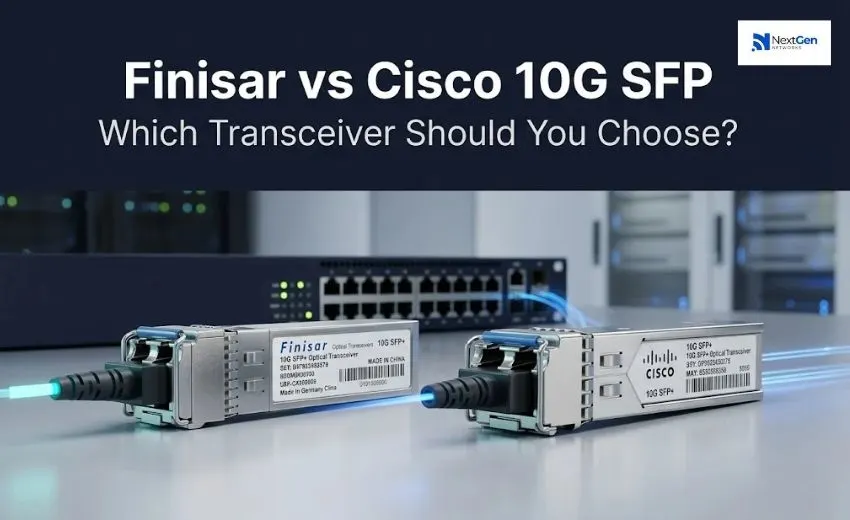
You’ve got a 10G port to fill, two part numbers on the quote, and a nagging question: does the brand on the label actually matter?
Sometimes it does, and sometimes it really doesn’t. Let’s walk through where the two differ so you can pick without second-guessing yourself.
The quick answer: for standard SR and LR links, the optics follow the same 10 Gigabit Ethernet specs, so reach and fiber requirements look much alike. The real differences are in coding, support, price, availability and operating environment. Those are the things to check.
First, a Quick Word on “10G SFP”
When people say “10G SFP,” they almost always mean SFP+. It’s the same size as a 1G SFP but runs at 10G. So before you order anything, make sure your port is actually a 10G-capable SFP+ port. A 1G-only SFP port won’t run a 10G module.
What You Get With a Finisar 10G SFP
Finisar is an optical component maker (it’s now part of Coherent), and its modules are sold by part number. A few examples:
- FTLX8571D3BCL: 10GBASE-SR/SW over multimode fiber at 850 nm, up to about 300 m on OM3 and 400 m on OM4.
- FTLX1471D3BCL: 10GBASE-LR/LW over single-mode fiber at 1310 nm, up to 10 km.
- FTLX8573D3BTL: the industrial-temperature version of the SR module, rated -40°C to +85°C.
- FTLX1471D3BCV: a dual-rate part that supports both 1G and 10G over single-mode fiber.
They use a duplex LC connector and support digital diagnostics, so you can watch optical power and temperature. Whether one works in your switch depends on how it’s coded for that platform.
What About a Cisco 10G SFP?
Cisco sells its own branded modules, each built and validated for Cisco platforms. The main ones are:
- SFP-10G-SR: multimode, up to 300 m on OM3 and 400 m on OM4.
- SFP-10G-LR: single-mode, up to 10 km.
- SFP-10G-ER: single-mode, up to 40 km.
- SFP-10G-ZR: single-mode, roughly 80 km. It’s built to Cisco’s own specification rather than the IEEE standard.
- SFP-10G-SR-X: an extended-temperature SR variant.
Cisco also sells “-S” versions (like SFP-10G-SR-S and SFP-10G-LR-S). They’re a lower-cost class with some feature limits. For example, Cisco’s datasheet says SFP-10G-LR-S doesn’t support FCoE. Check the datasheet for the exact part.
Side by Side
| Finisar | Cisco | |
| SR reach | About 300 m OM3 / 400 m OM4 | 300 m OM3 / 400 m OM4 |
| LR reach | 10 km | 10 km |
| Longer reach | Check the specific part | ER (40 km), ZR (~80 km) |
| Extra-wide temperature option | FTLX8573D3BTL (-40°C to +85°C) | SFP-10G-SR-X |
| Connector | Duplex LC | Duplex LC |
| Platform coding | Depends on how the part is coded | Built for Cisco platforms |
| Support path | Through your supplier | Through Cisco |
| Price | Varies by supplier | Varies by supplier |
Specs can vary by exact part number, so treat this as a starting point and check the datasheet.
What Actually Differs?
Coding and acceptance. Cisco switches check the module’s coding. A Cisco-branded module is built to pass that check. A Finisar module can work too, but only if it’s coded for your platform, so confirm it for your exact switch and software version.
Support and warranty. With a Cisco module, your support conversation runs through Cisco. With a Finisar module, it runs through whoever sold it to you. Ask what the warranty covers either way.
Price and availability. Prices move around and depend on the supplier, so get quotes for both. Don’t assume one is cheaper.
Environment. If the module will sit somewhere hot, cold or uncontrolled, look at the temperature rating first. Both brands offer options.
So Which One Should You Choose?
Here’s a simple way to think about it.
Go with Cisco when:
- You want the module and the switch under one support relationship
- Your organization requires Cisco-branded optics
- Your platform’s compatibility list names a specific Cisco part
Go with a Finisar 10G SFP when:
- You’re running mixed equipment and want one module family
- The module is confirmed as coded for your platform
- You need a specific variant, like the industrial-temperature or dual-rate part
And either way, match the fiber first. SR needs multimode, LR needs single-mode, and the two ends of a link must be the same type.
Common Mistakes to Avoid
- Ordering SR for a single-mode link (or the reverse)
- Assuming “same speed” means “same compatibility”
- Using APC patch cords. Cisco’s datasheet supports only PC or UPC.
- Skipping the compatibility check, then chasing an unsupported-transceiver error
- Forgetting to confirm your port is SFP+
A Few Quick Questions
Are Finisar and Cisco modules interchangeable on one link? Optically they can be, if both are the same type (say, SR to SR) and both are accepted by the equipment at each end. Check coding and compatibility first.
Is Cisco’s version better? Not automatically. It’s built for Cisco platforms and backed by Cisco, which matters in some environments. The optical specs for SR and LR are comparable.
Do I need a mode-conditioning cable? Only for LRM modules on older OM1 or OM2 fiber. It doesn’t apply to standard SR or LR.
Which is better for a 5 km link? Neither brand’s SR will do it. You need an LR module on single-mode fiber.
Where to Source Them
If you’re comparing both options, NextGen Networks lists Finisar and Cisco optical transceivers on its product pages, so you can look at part numbers side by side.
The Bottom Line
The choice between a Finisar module and a Cisco 10G SFP usually comes down to compatibility, support and budget, not raw optical performance. Pick the right fiber type and reach, confirm the part works with your switch, and then compare quotes. If you’d like a second pair of eyes, send your switch model and link details to NextGen Networks and ask for product details or a quotation.