



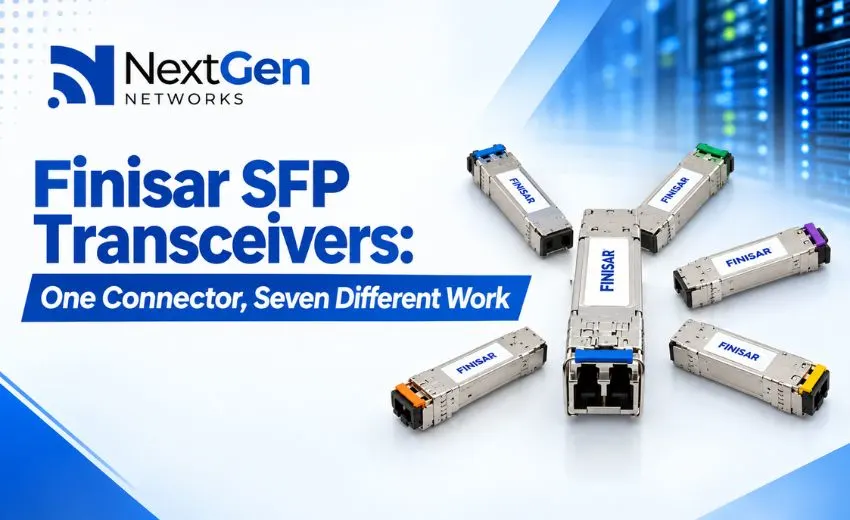
Finisar’s 25G-class SFP/SFP28 lineup looks deceptively uniform from the outside — most of these modules share the same duplex LC connector, the same 850nm VCSEL or 1310nm laser, and similar part-number prefixes. But the differences between them — reach, FEC dependency, single-rate vs. dual-rate, Ethernet vs. Fibre Channel — matter a great deal once you’re trying to match a module to an actual link. Here’s what each of these seven Finisar SFP optical transceivers actually does.
A Finisar SFP Optical Transceiver is designed to provide reliable optical connectivity for networking and data communication applications, but choosing the right model requires checking the transmission speed, fiber type, distance, and application.
FTLF8536P4BCL — Standard 25GE SR
The FTLF8536P4BCL is a straightforward 25.78 Gb/s SFP+ transceiver for short-reach multimode links. It uses an 850nm VCSEL laser, reaches 70m over OM3 fiber and 100m over OM4, and connects via duplex LC. It’s a single-rate module — no rate-select functionality — built for standard 25GE SR deployments and single-lane breakout from 100GE SR4 links.
Best for: Straightforward 25G Ethernet links within a data hall where reach stays under 100m.
FTLF8536P4PCL — 25GE SR With Extended Application Support
The FTLF8536P4PCL shares identical optical specifications with the FTLF8536P4BCL — same 850nm wavelength, same 70m/100m reach, same duplex LC connector. The difference is on the host electrical side and application qualification: Finisar lists this variant specifically for 25GE SR, 100G SR4 fan-out to 4x25GE SR, and eCPRI (Common Public Radio Interface, used in mobile fronthaul networks).
Best for: The same short-reach 25G links as the BCL variant, with added qualification for telecom fronthaul (eCPRI) applications.
FTLF8536P4PCV — Dual-Rate 25GE / 10GE SR Lite
This is the dual-rate member of the FTLF8536 family. Unlike the BCL and PCL variants, the PCV’s rate-select pins (RS0/RS1) are actively wired, letting the host switch the module between 10.3 Gb/s and 25.78 Gb/s operation. Optical specs otherwise match the rest of the family — 850nm, 70m OM3 / 100m OM4, duplex LC.
Best for: Deployments that need flexibility to run the same physical module at either 10G or 25G, without stocking two separate part numbers — also qualified for 100G SR4 fan-out and eCPRI.
FTLF8540P4BCL — Extended-Reach 25GE SR
The FTLF8540P4BCL steps up the reach considerably for a multimode 25G module — 300 meters, well beyond the 70–100m typical of standard SR-class parts in this family. It keeps the same 850nm VCSEL and duplex LC connector as the rest of the lineup.
Best for: Longer in-building or campus multimode runs where standard SR reach isn’t quite enough, but single-mode isn’t otherwise needed.
FTLF8538P4BCL — Extended Reach SR, FEC-Dependent
Despite the name, the FTLF8538P4BCL’s actual reach depends on which FEC (Forward Error Correction) mode the host applies. With RS-FEC, it reaches 70m OM3 / 100m OM4 — matching the standard FTLF8536 family. With Firecode FEC, reach drops to roughly 50m OM3 / 70m OM4, and with no FEC at all, it drops further to around 30m OM3 / 40m OM4.
Best for: Deployments where the host’s FEC configuration is already fixed and you need to confirm actual achievable reach before ordering — check your switch’s FEC mode before assuming maximum distance.
FTLF1436P4BCL — 25GE LR, Single-Mode Long Reach
The FTLF1436P4BCL is the single-mode option in this group — a 25GE LR SFP28 using a 1310nm DFB laser instead of a VCSEL, reaching 10 km over standard single-mode fiber. Connector and form factor stay consistent with the rest of the lineup (duplex LC, SFP28 footprint).
Best for: 25G Ethernet links between buildings or across a campus, where multimedia’s short reach isn’t sufficient and single-mode fiber is already in place or being newly run.
FTLF8532P4BCV — 32GFC Tri-Rate Fibre Channel
The odd one out in this group: the FTLF8532P4BCV isn’t an Ethernet module at all — it’s a Fibre Channel transceiver supporting three rates (8.5, 14.025, and 28.05 Gb/s), selectable via rate-select pins, over 850nm multimode fiber. Reach varies by rate: roughly 150m OM3 / 190m OM4 at 8.5 Gb/s, down to 70m OM3 / 100m OM4 at the full 28.05 Gb/s (32GFC) rate.
Best for: SAN (storage area network) connectivity where a single module needs to support multiple generations of Fibre Channel switches or storage arrays without a hardware swap.
Comparing the Lineup
The biggest practical split in this group is Ethernet vs. Fibre Channel, and multimode vs. single-mode. Six of the seven parts are 25G Ethernet modules over multimode fiber; only the FTLF1436P4BCL uses single-mode, and only the FTLF8532P4BCV is Fibre Channel rather than Ethernet. Within the Ethernet/multimode group, the real differences are reach (70–100m standard, up to 300m on the FTLF8540P4BCL, or FEC-dependent on the FTLF8538P4BCL) and rate flexibility (single-rate on most, dual-rate on the FTLF8536P4PCV).
Buying Guidance
Confirm Ethernet vs. Fibre Channel before ordering. The FTLF8532P4BCV looks similar to the FTLF8536 family at a glance — same connector, same general wavelength — but it’s built for Fibre Channel SAN traffic, not Ethernet. Ordering it for an Ethernet switch port won’t work as expected.
Check whether your reach genuinely needs an extended-range part. If your link is comfortably under 70–100m, the standard FTLF8536P4BCL covers it without paying for the extended reach of the FTLF8540P4BCL or navigating the FEC-dependent reach of the FTLF8538P4BCL.
Verify FEC configuration before relying on FTLF8538P4BCL’s maximum reach. Its distance figures shift meaningfully depending on whether your host applies RS-FEC, Firecode FEC, or no FEC at all — confirm your switch’s FEC setting before assuming the longest reach applies.
Match single-mode vs. multimode to your actual fiber plant. The FTLF1436P4BCL requires single-mode fiber; every other module in this group needs multimode. They aren’t interchangeable regardless of connector type.
If you need rate flexibility, the FTLF8536P4PCV avoids double-stocking parts. Its dual-rate support (10G/25G) can simplify sparing if your environment runs a mix of both speeds.
For the full specification sheets on these and other Finisar SFP modules, see NextGen Networks’ Finisar product page.
Frequently Asked Questions
What’s the difference between FTLF8536P4BCL and FTLF8536P4PCL?
They share identical optical specifications — 850nm, 70m OM3/100m OM4, duplex LC. The PCL variant is qualified specifically for 100G SR4 fan-out and eCPRI fronthaul applications alongside standard 25GE SR use.
Can FTLF8536P4PCV run at 10G and 25G on the same module?
Yes. It’s a dual-rate SFP+ with rate-select pins that let the host switch between 10.3 Gb/s and 25.78 Gb/s operation.
Why does FTLF8538P4BCL’s reach vary so much?
Its distance depends on the FEC mode applied by the host switch — RS-FEC gets the full 70m OM3/100m OM4, while Firecode FEC or no FEC at all reduce that range.
Is FTLF8532P4BCV an Ethernet transceiver?
No. It’s a Fibre Channel module supporting 8.5, 14.025, and 28.05 Gb/s (up to 32GFC) — used for SAN connectivity, not Ethernet switching.
What reach does FTLF1436P4BCL support?
Up to 10 km over standard single-mode fiber, using a 1310nm DFB laser — the only single-mode option in this group.
Which module has the longest multimode reach in this lineup?
The FTLF8540P4BCL, rated for 300 meters — well beyond the 70–100m typical of the standard FTLF8536 family.
Are these modules interchangeable with each other?
Only where both media type (multimode vs. single-mode) and application (Ethernet vs. Fibre Channel) match. A 25GE SR module and the 32GFC Fibre Channel module use similar connectors but aren’t functionally interchangeable.
Conclusion
Finisar’s SFP lineup may look similar physically, but the differences in reach, FEC requirements, operating rates, fiber type, and application can significantly affect network compatibility.
When selecting a Finisar SFP Optical Transceiver, start by confirming the application, fiber type, required transmission distance, operating speed, and host configuration. This simple checklist can help avoid compatibility problems and ensure the selected module is appropriate for the network.