



If you’re speccing a 40 Gigabit Ethernet link on Cisco hardware, these two transceivers are usually the first decision point: QSFP-40G-SR4 or QSFP-40G-LR4. They both deliver the same 40G throughput and slot into the same QSFP+ port, but they’re built for fundamentally different fiber infrastructure and link distances. Here’s exactly how they differ, verified against Cisco’s own datasheet, and how to pick the right one.
Quick Answer
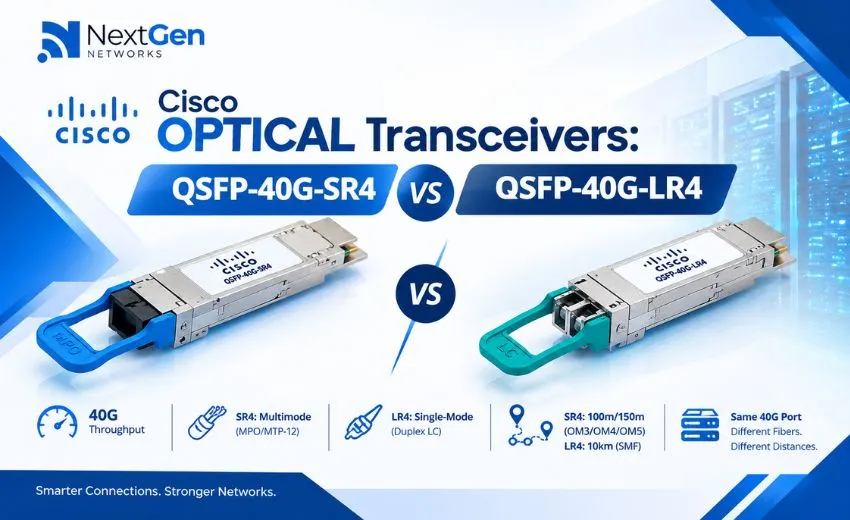
QSFP-40G-SR4 is a short-reach, multimode module — 100m on OM3 fiber, 150m on OM4/OM5 — using an MPO/MTP-12 parallel-fiber connector. QSFP-40G-LR4 is a long-reach, single-mode module — 10km on standard SMF — using a duplex LC connector. If your fiber run is inside a data hall on existing multimode cabling, SR4 is almost certainly the answer. If you’re connecting across a campus or between buildings on single-mode fiber, LR4 is the one you need.
QSFP-40G-SR4: Short-Reach Multimode
The QSFP-40G-SR4 is built to the IEEE 802.3ba 40GBASE-SR4 standard, using an 850nm VCSEL laser array over parallel multimode fiber. It connects via a 12-fiber MPO/MTP connector rather than the duplex LC most people associate with fiber optics.
Key specifications:
- Reach: 100 meters on OM3 fiber, 150 meters on OM4/OM5 fiber
- Wavelength: 850nm
- Fiber type: Parallel multimode fiber (MMF)
- Connector: MPO/MTP-12
- Minimum cabling distance: 0.5 meters
One practical feature worth knowing: the SR4 module supports 4x10G breakout mode, letting you split a single 40G port into four independent 10GBASE-SR links using an MPO-to-duplex-LC fanout cable. This makes it useful not just for native 40G links, but as a way to fan a single high-density switch port out to four separate 10G connections.
QSFP-40G-LR4: Long-Reach Single-Mode
The QSFP-40G-LR4 takes a completely different optical approach. Instead of four parallel multimode fibers, it multiplexes four CWDM wavelengths (in the 1310nm band) onto a single pair of single-mode fibers, using a standard duplex LC connector.
Key specifications:
- Reach: Up to 10 kilometers over standard G.652 single-mode fiber
- Wavelength: Four CWDM wavelengths in the 1310nm band, multiplexed
- Fiber type: Single-mode fiber (SMF)
- Connector: Duplex LC
- Minimum cabling distance: 2 meters
Because the four wavelengths are multiplexed onto a single fiber pair rather than run over four physically separate strands, the LR4 module doesn’t support the 4x10G breakout mode that the SR4 offers — it’s built strictly as a native 40G point-to-point link. Cisco’s datasheet also notes that QSFP-40G-LR4-S supports the 40GBASE Ethernet rate only, with no FCoE support.
Side-by-Side Comparison
| Factor | QSFP-40G-SR4 | QSFP-40G-LR4 |
| Standard | IEEE 802.3ba 40GBASE-SR4 | IEEE 802.3ba 40GBASE-LR4 |
| Fiber type | Multimode (parallel) | Single-mode |
| Wavelength | 850nm | 1310nm band (4x CWDM, multiplexed) |
| Max reach | 100m (OM3) / 150m (OM4/OM5) | 10 km |
| Connector | MPO/MTP-12 | Duplex LC |
| Min. cabling distance | 0.5 m | 2 m |
| 4x10G breakout support | Yes | No |
| Typical use case | In-building, short data hall links | Campus, inter-building, longer single-mode runs |
Which One Should You Choose?
Choose QSFP-40G-SR4 if:
- Your link is under 150 meters and multimode fiber is already installed
- You want the option to break a 40G port into four 10G links later
- You’re connecting switches within the same data hall or adjacent racks
Choose QSFP-40G-LR4 if:
- Your link needs to span more than 150 meters — between buildings, across a campus, or to a separate data hall
- Single-mode fiber is already in place, or you’re installing new fiber and want long-term reach flexibility
- You need a native point-to-point 40G link and don’t require breakout to 10G
A common mistake worth avoiding: ordering LR4 “to be safe” on a short in-building link. It costs more than SR4 and doesn’t offer breakout support — there’s no benefit to the extra reach if your actual link distance is well under 150 meters.
Buying Considerations
Match the connector to your existing cable plant. SR4 requires MPO/MTP-terminated multimode trunk cable; LR4 requires duplex LC single-mode fiber. These aren’t interchangeable, and ordering the wrong module for your installed fiber is one of the most common — and easily avoidable — mistakes.
Confirm your OM3 vs. OM4 fiber grade if going SR4. The jump from 100m to 150m reach depends entirely on fiber grade, not the module itself — check what’s actually installed before assuming maximum reach.
Decide on breakout needs upfront. If there’s any chance you’ll want to split the port into four 10G links later, SR4 keeps that option open; LR4 does not.
Check Cisco platform support for S-Class variants. Cisco’s “-S” suffix modules (QSFP-40G-SR4-S, QSFP-40G-LR4-S) are the standard current versions with guaranteed BER performance — confirm which variant your specific switch platform expects before ordering.
Frequently Asked Questions
Can QSFP-40G-SR4 and QSFP-40G-LR4 be used on the same link?
No. One end of a link must run matching optics — you can’t pair a multimode SR4 module with a single-mode LR4 module on the same fiber run.
Which module is cheaper, SR4 or LR4?
SR4 is generally the lower-cost option, given its simpler VCSEL-based optics compared to LR4’s CWDM multiplexing design. Exact pricing varies by supplier and whether the module is genuine Cisco or a tested compatible alternative.
Does QSFP-40G-LR4 support 4x10G breakout like SR4 does?
No. Because LR4 multiplexes its four wavelengths onto a single fiber pair rather than running them over separate physical strands, it doesn’t support breakout to four independent 10G links — it’s a native 40G point-to-point module only.
What’s the minimum distance for each module?
SR4 has a minimum cabling distance of 0.5 meters; LR4 requires a minimum of 2 meters, per IEEE 802.3 specifications.
Can I use QSFP-40G-SR4 over single-mode fiber?
No. SR4 is designed specifically for multimode fiber. Running it over single-mode fiber will not work correctly.
What connector does each module use?
SR4 uses an MPO/MTP-12 parallel-fiber connector. LR4 uses a standard duplex LC connector, the same type used on most single-mode Ethernet links.
Sourcing Cisco 40G Optics
NextGen Networks supplies genuine Cisco optical transceivers, including the QSFP-40G-SR4 and QSFP-40G-LR4, across the full 40G lineup — and can help confirm which module matches your existing fiber plant and switch platform before you order.
Conclusion
The choice between QSFP-40G-SR4 and QSFP-40G-LR4 comes down to two things: how far your link needs to travel, and what fiber is already in the ground. SR4 covers short multimode runs with the added flexibility of 10G breakout; LR4 covers long single-mode runs as a dedicated 40G point-to-point link. Match the module to your actual fiber type and distance, and the rest of the decision is straightforward.