



Moving a rack, row, or campus link to 40G looks simple until the parts list arrives. QSFP+ transceivers share one form factor, but they differ in fiber type, connector, and reach. A mismatch can leave a link that won’t come up, or a purchase that has to be redone. This guide explains six common 40G QSFP+ options so you can match the right module to your infrastructure.
What Is a QSFP+ Transceiver?
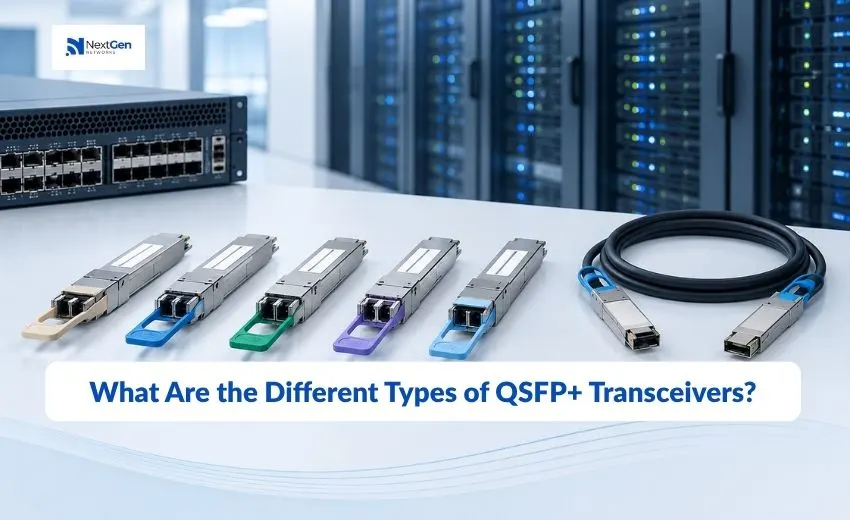
A QSFP+ (Quad Small Form-factor Pluggable Plus) transceiver is a hot-pluggable module that delivers 40 Gbps by combining four 10G lanes. QSFP+ transceivers are widely used in data center networking for switch uplinks, leaf-spine fabrics, server and storage connectivity, and campus aggregation. The same port can accept optical transceivers for multimode fiber or single-mode fiber, as well as direct attach copper cables. That flexibility is why choosing the right variant matters.
Different Types of QSFP+ Transceivers
QSFP+ SR4
QSFP+ SR4 (40GBASE-SR4) is a short-reach optical module for multimode fiber. It uses an MPO/MTP connector and four parallel 850 nm lanes. Typical reach is about 100 m on OM3 and 150 m on OM4. Consider it for in-row and in-building links where parallel fiber cabling is installed or planned. It can also support 40G-to-4×10G breakout with suitable cabling and switch support.
QSFP+ LR4
QSFP+ LR4 (40GBASE-LR4) sends four wavelengths over a duplex single-mode fiber pair with LC connectors, reaching up to 10 km. It suits campus backbones, metro links, and connections between buildings or data halls. Choose it when distance exceeds multimode limits and single-mode fiber is already in place.
QSFP+ ER4
QSFP+ ER4 (40GBASE-ER4) also uses duplex LC single-mode fiber but extends reach to roughly 40 km. It is relevant for long campus, metro, and inter-site data center links. Consider it only when the link needs that distance, and plan the optical link budget carefully.
QSFP+ SR-BiDi
QSFP+ SR-BiDi (SRBD) carries 40G over a duplex multimode fiber pair with LC connectors, using two wavelengths per fiber. Typical reach is about 100 m on OM3 and 150 m on OM4. Its main benefit is reusing existing duplex LC multimode cabling when upgrading from 10G, without installing MPO trunks. BiDi modules are normally deployed in matched pairs, so confirm compatibility at both ends.
QSFP+ LX4
QSFP+ LX4 multiplexes four CWDM wavelengths onto a duplex LC fiber pair. It is not part of the core IEEE 40GBASE lineup, so specifications are defined by the manufacturer. Many modules are specified for roughly 100–150 m on OM3/OM4 multimode, and some also support single-mode fiber over longer distances. Consider it for short duplex-fiber links, and verify the datasheet for the exact part.
QSFP+ DAC
QSFP+ DAC is a direct attached copper assembly: twinax cable with QSFP+ connectors fixed at both ends and no separate optics. Passive versions typically cover a few meters (around 5 m is common), and some active versions are available. It suits top-of-rack links between servers and switches, or between adjacent racks.
QSFP+ Transceiver Comparison
| Type | Media | Approx. Reach | Connector / Cabling | Ideal Application |
| SR4 | Multimode (OM3/OM4) | ~100 m / ~150 m | MPO/MTP | In-row, in-building, breakout |
| LR4 | Single-mode | Up to 10 km | Duplex LC | Campus and metro links |
| ER4 | Single-mode | Up to ~40 km | Duplex LC | Long campus, inter-site links |
| SR-BiDi | Multimode (OM3/OM4) | ~100 m / ~150 m | Duplex LC | Reusing duplex multimode fiber |
| LX4 | Multimode; some models single-mode | Vendor-specific | Duplex LC | Short duplex-fiber links |
| DAC | Copper twinax | Typically a few meters | Fixed QSFP+ ends | Intra-rack and adjacent racks |
Specifications vary by manufacturer and exact part number, so confirm the datasheet before ordering.
How to Choose the Right QSFP+ Transceiver
Distance. Start with the link length. Within a rack, DAC is usually sufficient. Up to about 100–150 m, consider SR4 or SR-BiDi. Beyond that, move to LR4 (10 km) or ER4 (about 40 km).
Fiber infrastructure. Existing multimode fiber points toward SR4, SR-BiDi, or LX4. Existing single-mode fiber points toward LR4 or ER4. Check the fiber grade (OM3 or OM4), since reach depends on it.
Connector type. SR4 needs MPO/MTP parallel fiber. SR-BiDi, LR4, ER4, and LX4 use duplex LC. If your patching is LC-based, avoid SR4 unless you plan to re-cable.
Equipment compatibility. Switches and NICs may only accept certain modules or cable types. Confirm the platform, model, and software version, along with the module’s electrical and optical specifications.
Deployment requirements. Consider port density, breakout needs, future upgrade paths, and whether the link is permanent or likely to be re-patched. DAC cables cannot be re-terminated, while optical modules can be paired with different fiber runs.
Why Source QSFP+ Transceivers from NextGen Networks?
NextGen Networks supplies optical transceivers and networking hardware to enterprise, data center, and telecom customers. Its website lists SFP, SFP+, QSFP, and CFP modules (1G–800G), DAC/AOC cables, and fiber patch cords. It also lists products from brands including Cisco, Finisar, Arista, Juniper, Palo Alto, Fortinet, Ruckus, and CommScope, and describes multi-vendor compatibility. Its Cisco listings include QSFP-40G-SR4, QSFP-40G-LR4-S, and QSFP-40/100-SRBD. For data center projects, the company also offers switch deployment, structured cabling, and high-speed interconnect support, including 40G.
Availability varies by variant and platform, so confirm specific requirements, including ER4, LX4, and QSFP+ DAC, with the team directly.
Conclusion
Each 40G QSFP+ option fits a different job:
- SR4 for short multimode links over MPO.
- SR-BiDi for duplex multimode reuse.
- LX4 for vendor-defined duplex-fiber cases.
- LR4 for up to 10 km on single-mode.
- ER4 for about 40 km.
- DAC for short in-rack connections.
Matching distance, fiber, connector, and equipment compatibility up front avoids rework.
To discuss compatible QSFP+ transceivers for your network, contact NextGen Networks at sales@nextgennetworks.in or +91-9650398500, or use the Contact Us page. Share your switch models, fiber type, and link distances, and the team can help you identify suitable options.