



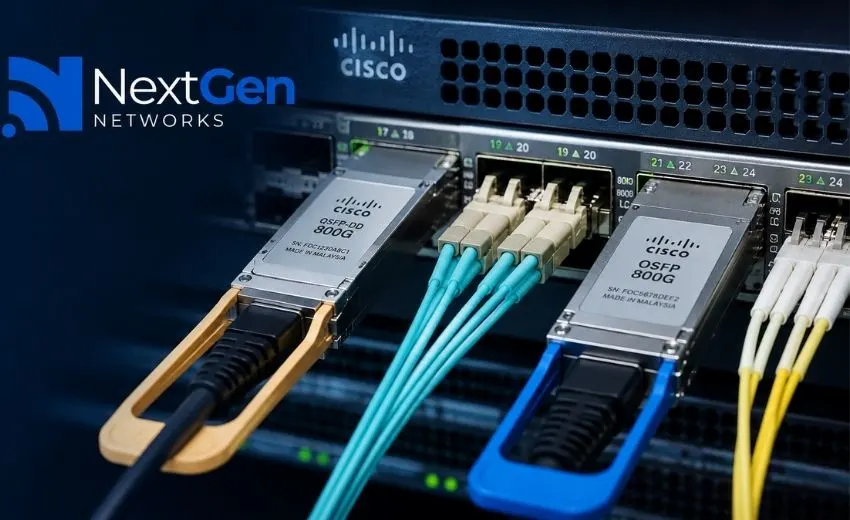
If you’ve been sourcing Cisco optical transceivers for a network refresh, you’ve likely noticed the lineup has moved well past the CFP2 and CPAK modules that defined Cisco’s first generation of 100G and 400G optics. The current generation runs on QSFP-DD and OSFP form factors, with part numbers like QDD-400G-DR4-S, QDD-400G-FR4-S, and OSFP-800G-DR8 — and Cisco’s own documentation now frames this lineup explicitly around AI data center fabrics, not just general-purpose Ethernet. Here’s what each option actually does and how to pick the right one.
Why This Generation Looks Different
Cisco’s newer QSFP112-based 400G modules and OSFP 800G modules are qualified specifically for the breakout patterns AI clusters rely on — 400G splitting into 4x100G or 2x200G, and 800G splitting into 2x400G, 4x200G, or 8x100G. That’s a deliberate design choice: modern GPU servers and NICs often need exactly this kind of flexible fan-out, and Cisco’s qualification testing now explicitly includes these breakout architectures alongside standard point-to-point links.
The 400G QSFP-DD Lineup
| Model | Standard | Fiber | Reach | Connector |
| QDD-400G-DR4-S | 400GBASE-DR4 | Parallel SMF | 500 m | MPO-12 |
| QDD-400G-FR4-S | 400GBASE-FR4 | Duplex SMF | 2 km | Duplex LC |
| QDD-400G-VR4 | 400GBASE-VR4 | Parallel MMF | 30 m OM3 / 50 m OM4-OM5 | MPO-12 |
| QDD-400G-SR8-S | 400GBASE-SR4-class | Parallel MMF | 100 m OM4 | MPO-16 APC |
QDD-400G-DR4-S is the straightforward short single-mode option — 500 meters over parallel SMF via MPO-12, with breakout support down to 4x100G or 2x200G. It’s a common choice for switch-to-switch links within a single data hall.
QDD-400G-FR4-S trades the parallel-fiber MPO connector for a duplex LC connection, using four CWDM wavelengths (1271, 1291, 1311, and 1331nm) multiplexed onto a single fiber pair. It reaches 2 km — useful when you want single-mode reach without the fiber-count overhead of a parallel MPO cable, or when you’re migrating from existing duplex fiber infrastructure.
QDD-400G-VR4 is built for very short multimode reach — 30 to 50 meters — and is specifically noted by Cisco as interoperable with 400GBASE-SR4 and usable in 800GBASE-VR8/SR8 breakout modes, making it a common pick for dense in-rack GPU server connectivity.
QDD-400G-SR8-S spreads the 400G signal across eight multimode fiber pairs via an MPO-16 APC connector, reaching 100 meters on OM4. It supports breakout to 8x50GE or 2x200GE, which matters if your NICs or switches are provisioned at those speeds.
The 800G OSFP Lineup
OSFP-800G-DR8 and its higher-power OSFP-800G-DR8P variant support 800GBASE-DR8 over eight pairs of single-mode fiber via dual MPO-12 APC connectors, reaching 500 meters. Both support breakout to 2x400GBASE-DR4, 4x200GBASE-DR2, or 8x100GBASE-DR1 — and critically, Cisco’s own datasheet specifically calls these out as intended for AI applications across both front-end and back-end networks. They’re also field firmware-upgradeable under the CMIS 5.3 process, which matters for long-term platform support as standards evolve.
For longer-distance connectivity between sites, Cisco’s 800G ZR/ZR+ coherent optics (available in both QSFP-DD and OSFP form factors) carry 800G traffic over amplified DWDM links — up to roughly 120 km for 800ZR and beyond 1,000 km for 800G ZR+, aimed at data center interconnect rather than in-building links.
Genuine Cisco vs. Cisco-Compatible: What Actually Matters Here
This generation of optics makes the genuine-versus-compatible question more consequential than it used to be. Two things are worth understanding before you order:
FEC is handled by the host platform, not the module, across this entire generation — DR4, FR4, VR4, and SR8 modules all rely on the switch or NIC ASIC to perform forward error correction. That means compatibility isn’t just about the optic plugging in physically; the host platform’s NX-OS or IOS-XE release, and whether it applies the right FEC mode automatically or requires explicit configuration, matters just as much as the transceiver itself.
Coding and validation against Cisco’s TMG matrix determines whether a module comes up cleanly. Cisco publishes a Transceiver Module Group (TMG) Compatibility Matrix specifying which optics are validated against which switch and NIC platforms. A properly coded Cisco-compatible module tested against that matrix will interoperate correctly; a mismatched or uncoded one is the most common cause of “transceiver validation failed” errors on Cisco platforms.
Buying Considerations
Match reach to your actual link before defaulting to FR4. DR4’s 500m parallel-SMF reach covers most in-building links at a lower cost than FR4’s duplex-LC 2km option — only pay for the extra reach and fiber-count savings if you actually need it.
Confirm breakout mode support on both ends. If you’re planning to break an 800G OSFP-DR8 port down to 2x400G or 4x200G, verify both the switch and the receiving devices support that specific breakout configuration before ordering cabling.
Check APC vs. UPC connector requirements. Several modules in this generation — including QDD-400G-SR8-S, QDD-400G-DR4-S, and the OSFP-800G-DR8 — require APC (angled) MPO connectors rather than standard UPC patch cords. Ordering the wrong polish type is an easy, avoidable mistake.
Verify FEC configuration on your NX-OS/IOS-XE release. Since FEC is host-side on this entire generation, confirm whether your specific software release enables the required FEC mode automatically on these interfaces or needs explicit configuration.
Frequently Asked Questions
What’s the difference between QDD-400G-DR4-S and QDD-400G-FR4-S?
DR4 uses parallel single-mode fiber via MPO-12, reaching 500m. FR4 uses duplex single-mode fiber via LC connectors with CWDM wavelength multiplexing, reaching 2km — a fiber-count trade-off for extra reach.
Is OSFP-800G-DR8 used specifically for AI networking?
Cisco’s own datasheet identifies it for AI applications across both front-end and back-end data center networks, alongside general high-performance computing and enterprise use.
Can I break out an 800G OSFP-DR8 port to smaller speeds?
Yes — it supports breakout to 2x400GBASE-DR4, 4x200GBASE-DR2, or 8x100GBASE-DR1, provided both ends of the link support the same breakout configuration.
Does the module handle forward error correction, or does the switch?
Across this generation — DR4, FR4, VR4, and SR8 — FEC is performed by the host platform, not the optical module itself.
What causes “transceiver validation failed” errors on Cisco switches?
Most commonly, an optic that isn’t properly coded or validated against Cisco’s Transceiver Module Group (TMG) Compatibility Matrix for your specific platform and software release.
Are Cisco-compatible 400G/800G optics reliable for production use?
Yes, when properly coded and tested against the same MSA and IEEE standards, and validated for interoperability with your specific Cisco platform — genuine Cisco optics and properly qualified compatible modules both see production use.
What’s the reach difference between 800G DR8 and 800G ZR/ZR+?
DR8 is a short-reach parallel-fiber module for in-building links up to 500m. ZR/ZR+ are coherent DWDM optics for much longer distances — up to roughly 120km (ZR) or beyond 1,000km (ZR+) — used for data center interconnect rather than in-building connectivity.
Sourcing Cisco 400G and 800G Optics
NextGen Networks stocks both genuine Cisco optics and tested, MSA-compliant Cisco-compatible alternatives across this full 400G/800G lineup, cross-referenced against Cisco’s official compatibility matrix before shipping — helping you avoid the validation errors that come with mismatched third-party optics.
Conclusion
Cisco’s move to QSFP-DD and OSFP form factors brought more than a physical redesign — this generation of Cisco Optical Transceivers, including DR4, FR4, VR4, SR8, and DR8 optics, is explicitly built around the breakout flexibility and AI fabric use cases that CFP2 and CPAK never needed to handle.