



A modern network is only as strong as the connections that carry its data.
As businesses move more applications to the cloud, data centers handle larger workloads, and organizations rely on faster digital services, network traffic continues to grow. A connection that worked well yesterday may not provide enough capacity tomorrow.
This is where Palo Alto optical transceivers can become an important part of a scalable fiber networking strategy. Available across multiple speeds and form factors, these compact modules help connect compatible networking equipment over fiber and support different enterprise and data center requirements.
Why Do Optical Transceivers Matter?
Think of an optical transceiver as a bridge between networking equipment and the fiber infrastructure that carries data.
The module converts electrical signals into optical signals for transmission through fiber and converts incoming optical signals back into electrical signals. This makes transceivers an essential component in many high-speed network connections.
When selecting Palo Alto Optical Transceivers, it is important to look beyond speed. Network requirements can vary depending on the equipment, fiber infrastructure, transmission distance, and application.
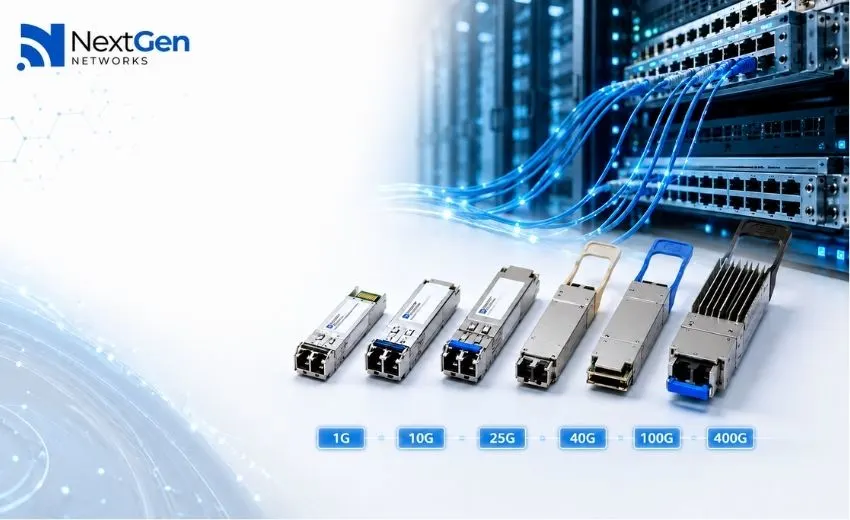
From 1G to 400G: One Network, Many Possibilities
One of the biggest advantages of having different optical transceiver options is flexibility.
A small enterprise network may only require 1G connectivity. A growing data center might need 10G or 25G connections, while high-performance infrastructure may require 100G or 400G links.
A broad Palo Alto transceiver portfolio can support this progression.
1G SFP: A Practical Starting Point
1G SFP transceivers remain useful for many Gigabit Ethernet applications. They can provide fiber connectivity for compatible networking equipment where 1G bandwidth is sufficient.
Options include:
- 100BASE-FX
- SFP-SX
- SFP-LX
- SFP-ZX
- SFP-CG
- SFP-EX
The best option depends on the equipment and the characteristics of the fiber link.
10G SFP+: More Bandwidth for Growing Networks
When network traffic increases, moving from 1G to 10G can provide a significant bandwidth upgrade.
10G SFP+ options include:
- 10GBASE-SR
- 10GBASE-LR
- 10GBASE-ER
- 10GBASE-T
These modules can be considered for enterprise networks, server connections, and suitable data center deployments.
The important point is to match the module with the equipment and cabling rather than selecting a transceiver based on speed alone.
25G SFP28: A Step Toward Higher Performance
For networks that need more bandwidth than 10G but do not necessarily require 100G at every connection, 25G can provide an attractive middle ground.
25G SFP28 options include:
- 25GBASE-SR
- 25GBASE-LR
These modules can be useful in compatible data center and high-performance networking environments.
When 40G and 100G Become the New Normal
As network traffic continues to increase, higher-speed connectivity becomes increasingly important.
40G QSFP transceivers provide another bandwidth option, with technologies such as:
- 40GBASE-SR4
- 40GBASE-LR4
- 40GBASE-LM4
- 40GBASE-BiDi
- 40GBASE-ER4
For even greater capacity, 100G QSFP28 transceivers can support high-speed connections in suitable network environments.
Available options include:
- 100GBASE-SR4
- 100GBASE-LR4
- 100GBASE-CWDM4
- 100GBASE-BiDi
- 100GBASE-ER4
The choice between these technologies depends on the network architecture, fiber infrastructure, equipment compatibility, and required link characteristics.
400G: Preparing for the Next Generation
Cloud computing, AI workloads, virtualization, high-performance applications, and rapidly growing data volumes are pushing network infrastructure toward even higher speeds.
For these demanding environments, 400G QSFP-DD transceivers provide a high-capacity connectivity option.
The range includes solutions such as:
- 400GBASE-SR8
- 400GBASE-LR4
- 400GBASE-ZR
- 4×100GBASE-LR
At this level, careful planning becomes even more important. Network teams should verify the supported interface, optical specifications, fiber infrastructure, and equipment compatibility before deployment.
How Do You Choose the Right Palo Alto Transceiver?
Choosing an optical transceiver doesn’t have to be complicated when you approach it systematically.
Start with these five questions:
- What speed do you need?
Determine whether your connection requires 1G, 10G, 25G, 40G, 100G, or 400G. - What interface does your equipment support?
The transceiver form factor must match the available interface. - What type of fiber are you using?
Check whether your infrastructure uses single-mode or multimode fiber and select a compatible solution. - How far does the connection need to travel?
Different optical technologies are intended for different link requirements. - Is the module compatible with your equipment?
Always verify compatibility with the specific Palo Alto networking equipment before purchase or installation.
The Right Module Can Make Network Planning Easier
Network upgrades rarely happen overnight.
An organization may begin with 1G connections, move to 10G as traffic grows, introduce 25G for higher-performance applications, and eventually deploy 100G or 400G links in areas that demand greater capacity.
Having access to multiple transceiver speeds and form factors allows network teams to select solutions according to the needs of each connection instead of applying a single technology everywhere.
Final Thoughts
Optical transceivers may be small components, but they play a major role in modern fiber connectivity.
From 1G SFP to 400G QSFP-DD, the right transceiver can help organizations address different bandwidth and infrastructure requirements while planning for future network growth.
The key is not simply choosing the fastest module. It is choosing the right combination of speed, form factor, fiber type, transmission requirements, and equipment compatibility for the application.
With a well-planned approach to optical connectivity, businesses and data centers can create network infrastructure that is ready to handle today’s traffic while providing a path toward tomorrow’s higher bandwidth demands.