



Table of Contents
- What Is a 10G Optical Transceiver?
- Types of 10G Optical Transceivers
- SFP+ vs Other 10G Form Factors
- Leading Brands and Representative Models
- How to Choose the Right 10G Optical Transceiver
- 10G SR vs LR vs ER vs ZR
- Single-Mode vs Multimode
- 10G BiDi vs Duplex SFP+ Modules
- Common Applications
- Compatibility Checklist
- Buying 10G Optical Transceivers in India
- FAQ
- Conclusion
10 Gigabit Ethernet is now a baseline requirement across enterprise networks, data centers, campus backbones, telecom aggregation, and storage fabrics. As servers, wireless controllers, and firewalls outgrow 1G uplinks, the question shifts from whether to adopt 10G to which module fits each link.
A 10G transceiver provides optical or copper connectivity between compatible networking devices. SFP+ is the most common 10G form factor today, though older platforms still use XFP and XENPAK. Choosing correctly depends on reach, fiber type, wavelength, connector, switch compatibility, operating environment, and deployment requirements. A module that matches on speed but not on fiber, wavelength, or platform support can mean a link that never comes up.
This guide explains the main 10G module types, compares brand model families listed by NextGen Networks, and gives a practical framework for selection. NextGen Networks is a networking solutions provider; availability, pricing, and compatibility for any specific part should always be confirmed with the team before ordering.
What Is a 10G Optical Transceiver?
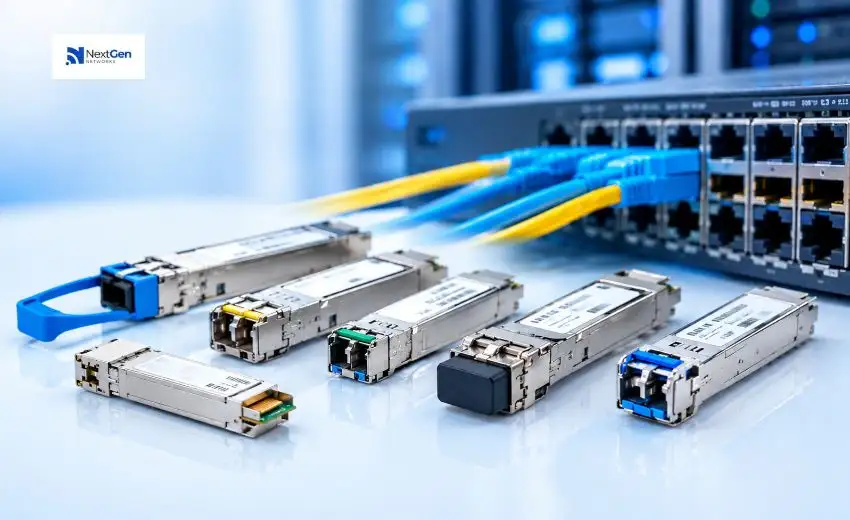
A transceiver is a hot-pluggable module that sits in a switch, router, firewall, or network card port and handles both sending and receiving. In an optical module, a laser converts electrical signals from the host device into light for transmission, and a photodiode converts incoming light back into electrical signals. This electrical-to-optical and optical-to-electrical conversion lets the same host port support different distances and fiber types simply by swapping modules.
In 10GbE networks, SFP+ modules fill this role. They are compact, support digital diagnostics, and can be replaced without powering down the device.
Optical modules differ from copper-based 10GBASE-T SFP+ modules, which carry 10G over twisted-pair cabling and are not optical transceivers at all. Both fit SFP+ ports, but their cabling, power draw, and reach limits differ.
Common deployment environments include top-of-rack and aggregation switches, server and storage links, campus backbones, firewall interfaces, and service provider access networks.
An important caution: SFP+ describes a module form factor and interface family. It does not guarantee that every SFP+ module works on every switch. Port support, software version, and vendor coding policies all affect compatibility, a point covered in the checklist below.
Types of 10G Optical Transceivers
All distances below are indicative. Actual performance depends on the exact module, fiber specification, link budget, connectors, and equipment, and specifications vary by manufacturer and part number.
10G SR: Short Reach
A 10G SR transceiver is the most common choice for short links over multimode fiber. It typically operates at 850 nm and uses duplex LC connectors. Under applicable specifications, 10GBASE-SR reaches up to 300 m over OM3 and 400 m over OM4. It suits short data center and enterprise connections such as server-to-switch or switch-to-switch links within a building.
10G LRM: Long Reach Multimode
10GBASE-LRM was designed for certain legacy multimode installations. It is commonly associated with reach up to 220 m under specified fiber conditions. Supported fiber types and launch conditions matter here, so verify that your installed cabling meets the module’s requirements before deploying LRM optics.
10G LR: Long Reach
A 10G LR transceiver is used over single-mode fiber. 10GBASE-LR reaches up to 10 km at a common wavelength of 1310 nm, with duplex LC connectors. It is typical for campus backbones, enterprise links between buildings, and metro-access connections within its supported reach.
10G ER: Extended Reach
A 10G ER transceiver is commonly associated with single-mode links up to 40 km in standard 10GBASE-ER implementations, at a wavelength around 1550 nm. At this distance, optical power budget, fiber attenuation, and link engineering become important. Splices, connectors, and patch panels all consume budget.
10G ZR: Very Long Reach
A 10G ZR transceiver is used for certain longer-distance 10G optical links. Some modules are specified around 70 to 80 km, but exact reach depends on the product’s design and optical budget. 80 km is not a universal standard for all ZR modules, so always check the manufacturer’s specification.
10G BiDi: Bidirectional
A 10G BiDi transceiver transmits and receives on different wavelengths over a single fiber strand. BiDi modules are deployed in complementary pairs, commonly labeled BX-U and BX-D. The two ends must have compatible, complementary wavelengths and a supported reach. BiDi is useful when fiber availability is limited.
10GBASE-T / Copper SFP+
10GBASE-T SFP+ modules provide 10G over supported twisted-pair copper. Key considerations include the supported cable category, maximum channel length, the module’s power consumption, and the switch’s thermal limits. These modules are not optical transceivers, and they should not be treated as interchangeable with fiber modules.
Industrial and Extended-Temperature Modules
Operating temperature and environmental conditions matter for outdoor cabinets, factory floors, and telecom enclosures. A suffix or model name alone does not establish the full temperature rating, so check the datasheet for the exact part.
Comparison Table
| Transceiver type | Typical fiber or medium | Typical wavelength | Representative reach | Common application | Key selection consideration |
| SR | Multimode (OM3/OM4) | 850 nm | Up to 300 m (OM3), 400 m (OM4) | Data center and in-building links | Fiber grade and installed distance |
| LRM | Multimode (legacy) | Per datasheet | Up to 220 m under specified conditions | Legacy multimode upgrades | Fiber type and launch conditions |
| LR | Single-mode | 1310 nm | Up to 10 km | Campus, enterprise, metro-access | Single-mode fiber availability |
| ER | Single-mode | ~1550 nm | Up to 40 km | Long campus and metro links | Optical power budget |
| ZR | Single-mode | ~1550 nm (typical) | Vendor-specific, around 70 to 80 km | Very long links | Manufacturer specification |
| BiDi | Single-mode or multimode, one strand | Complementary pair | Per datasheet | Fiber-constrained routes | Matched BX-U/BX-D pairing |
| 10GBASE-T | Twisted-pair copper | Not applicable | Per cable category and module | Short copper links | Cable category, power, thermal limits |
Distances are indicative, not universal guarantees.
SFP+ vs Other 10G Transceiver Form Factors
SFP+ is the current mainstream 10G form factor. XFP is an older, physically larger 10G format found on earlier routers and switches. XENPAK is older still and larger again, associated with early 10G platforms.
Key differences include:
- Physical size and port density: SFP+ is the most compact, which is why it dominates modern switches.
- Platform support: Each form factor needs a matching port. They are not interchangeable simply because they support 10G.
- Power and thermal considerations: Larger, older formats generally have different power and cooling profiles than SFP+. Confirm figures in the module datasheet.
Always check the form factor against your networking device before ordering.
Leading Brands and Representative 10G Transceiver Models
The models below come from product listings. They are candidates to investigate, not a statement that any model is currently in stock or available for dispatch. Confirm exact part numbers, specifications, and availability with the team and the manufacturer’s datasheet.
Finisar 10G Transceivers
The Finisar page describes the following 10G part numbers.
| Verified model | Module type | Typical application | Key verification point |
| FTLX1471D3BCL | 10G SFP+, single-mode | 10GBASE-LR links up to 10 km | Site text describes it as a limiting module; check host EDC PHY settings |
| FTLX8574D3BCL | 10G SFP+, multimode | 10GBASE-SR links over multimode fiber | Same limiting-module note applies |
| FTLX8574D3BCV | 1G/10G dual-rate SFP+, multimode | Dual-rate SR links | For 10G SFP+ and 1G/10G SFP+ ports, not native 1G SFP ports |
The Finisar page lists many more part numbers (the site indicates a catalogue of roughly 1,500 linked products). The listing includes other FTLX-series parts, but without descriptions for them in the information reviewed, confirm each datasheet before relying on reach or wavelength.
Cisco 10G SFP+
NextGen Networks lists Cisco-branded optics including SFP-10G-ER-S and SFP-10G-BXU-I. Review each listing and the Cisco datasheet for reach, wavelength, and platform support.
Ruckus 10G Transceivers
All of the following appear on the Ruckus page.
| Verified model | Module type | Typical application | Key verification point |
| 10G-SFPP-SR, 10G-SFPP-SR-S, 10G-SFPP-SR-SA | 10G SFP+ short reach | Short multimode links | Confirm what the suffixes mean on the datasheet |
| 10G-SFPP-USR | 10G SFP+ | Very short links | Confirm reach and fiber grade |
| 10G-SFPP-LR, 10G-SFPP-LR-S, 10G-SFPP-LR-SA | 10G SFP+ long reach | Single-mode links | Confirm reach and suffix meaning |
| 10G-SFPP-LRM | 10G SFP+ | Legacy multimode links | Fiber type and launch conditions |
| 10G-SFPP-ER | 10G SFP+ extended reach | Longer single-mode links | Optical power budget |
| 10G-SFPP-ZR | 10G SFP+ very long reach | Very long links | Vendor-specific reach |
| 10G-SFPP-BXD-ER, 10G-SFPP-BXU-ER, 10G-SFPP-BXD-S, 10G-SFPP-BXU-S | Bidirectional (BXD/BXU naming) | Single-strand fiber links | Deploy as matched D/U pairs; confirm wavelengths and reach |
Aruba / HPE 10G Transceivers
The Aruba Transceivers page lists the name families SFP-10G-SR, SFP-10G-LR, SFP-10G-ER, SFP-10G-ZR, and SFP-10G-T, alongside Aruba and HPE-style part numbers that the page does not describe individually. These generic-looking names should be treated as listing names rather than confirmed Aruba SKUs until checked against Aruba or HPE documentation.
Typical use cases follow the standard categories: SR for short multimode, LR for single-mode campus links, ER and ZR for longer reach, and T for copper. Exact compatibility depends on switch model, software and firmware, hardware revision, and manufacturer guidance.
Arista 10G SFP+
The Arista page lists the following 10G names. Verify the exact Arista part numbers and product support before publishing or ordering, because generic naming conventions do not confirm Arista SKUs.
| Listed model | Module type | Typical application | Key verification point |
| SFP-10G-SR, SFP-10G-SRL | Short reach, multimode | Short data center links | Confirm reach and the meaning of the L variant |
| SFP-10G-LR, SFP-10G-LRL | Long reach, single-mode | Campus and metro-access links | Confirm reach and the L variant |
| SFP-10G-ER, SFP-10G-ZR | Extended and very long reach | Longer single-mode links | Optical budget; vendor-specific reach |
| SFP-10G-ERBD-D/-U, SFP-10G-ERLBD-D/-U | Listed in D/U pairs, consistent with bidirectional use | Single-strand links | Confirm wavelengths and pairing on the datasheet |
| SFP-10G-T, SFP-10G-T-RP, SFP-10G-DZ-T | T-suffixed, likely copper | Short copper links | Confirm cable category, length, and power |
Palo Alto Networks 10G Transceivers
Verified on the Palo Alto page: PAN-SFP-PLUS-SR, PAN-SFP-PLUS-LR, PAN-SFP-PLUS-ER, and PAN-SFP-PLUS-10GBASE-T. The page also lists XFP variants (PAN-XFP-SR and PAN-XFP-LR), which are a different form factor.
In firewall and security-appliance deployments, transceiver compatibility matters because interfaces can be tied to specific supported modules. Do not assume universal compatibility across all Palo Alto Networks appliances; check the exact appliance model and software version.
Alcatel-Lucent Enterprise (ALE) 10G Transceivers
The ALE listings include SFP+, XFP, and other forms. Grouping them correctly is important.
| Verified model | Likely form factor | Typical application | Key verification point |
| SFP-10G-GIG-SR, SFP-10G-GIG-LR | SFP-style, 10G naming | Short and long-reach links | Confirm dual-rate behavior on datasheet |
| SFP-10G-ZR | SFP-style | Very long reach | Vendor-specific reach |
| SFP-10G-BX-D, SFP-10G-BX-U | SFP-style, bidirectional pair | Single-strand fiber links | Deploy as matched pair |
| SFP-10G-T | SFP-style, T suffix | Copper link | Cable category and power |
| iSFP-10G-SR | SFP-style | Short reach | Do not assume a temperature rating from the prefix |
| 10G-XFP-SR, 10G-XFP-LR, XFP-10G-SR | XFP | Legacy XFP ports | Not SFP+ |
| OM-10GNI-SR, OM-10GNI-LR | Not confirmed on the site | Legacy platforms | Confirm form factor before use |
A matching 10G speed does not mean the XFP or other legacy modules fit SFP+ ports.
How to Choose the Right 10G Optical Transceiver
- Transmission distance: Match the link distance to the supported reach and optical budget.
- Fiber type: Confirm single-mode or multimode, fiber grade, and installed cabling.
- Wavelength: Ensure the module’s wavelength suits the fiber and any BiDi or multiplexing requirements.
- Connector type: Verify LC or any other specified connector, and fiber polarity.
- Switch and device compatibility: Check the exact switch, router, firewall, NIC, or appliance model and its supported transceiver list.
- Form factor: Confirm SFP+, XFP, XENPAK, or the exact supported interface.
- Operating temperature: Check the datasheet for commercial or industrial requirements.
- Optical link budget: Account for fiber attenuation, connectors, splices, and other losses.
- Power and thermal requirements: Particularly important for copper SFP+ modules and densely populated switches.
- OEM or third-party requirements: Confirm device support policies and coding requirements before ordering.
A simple example: A team connecting two switches in the same data center row with 60 m of OM4 multimode fiber would look at an SR module, which fits well within typical SR reach. A second team linking two campus buildings 4 km apart over single-mode fiber would look at an LR module instead. Using SR on single-mode fiber, or LR on short multimode, would not work as intended.
10G SR vs LR vs ER vs ZR
| SR | LR | ER | ZR | |
| Typical reach | Up to 300 m (OM3) / 400 m (OM4) | Up to 10 km | Up to 40 km | Vendor-specific, around 70 to 80 km |
| Fiber type | Multimode | Single-mode | Single-mode | Single-mode |
| Typical wavelength | 850 nm | 1310 nm | ~1550 nm | ~1550 nm (typical) |
| Common deployment | Data center, in-building | Campus, metro-access | Long campus, metro | Very long links |
| Main selection consideration | Fiber grade | Single-mode availability | Link budget | Manufacturer spec |
Longer reach does not automatically mean better performance. The right module is the one matched to the actual link, fiber, and budget.
Single-Mode vs Multimode 10G Transceivers
Single-mode fiber has a very small core and carries one light path, which supports long distances. Multimode fiber has a larger core and carries multiple light paths, which suits shorter runs.
- Typical use cases: Multimode for in-building and data center links; single-mode for campus, metro, and long-distance links.
- Reach: Single-mode modules generally reach farther, but reach depends on the specific module.
- Installation and cabling: The decision often follows the fiber already in the ground or the building.
- Matching to the plant: Identify the installed fiber type and grade, then choose a module for it.
Neither fiber type is always cheaper or better. Total cost depends on installed cabling, distance, optics, and infrastructure.
10G BiDi vs Duplex SFP+ Modules
- Fiber strands: BiDi uses one strand; duplex uses two.
- Wavelengths: BiDi modules transmit and receive on complementary wavelengths, while duplex modules typically use the same wavelength family in both directions.
- Pairing: BiDi modules must be used in matched pairs, such as BX-U with BX-D.
- Benefits: BiDi can save fiber on routes where strands are limited.
- Verification: Confirm compatibility, wavelengths, and reach on the datasheet before ordering.
Common Applications of 10G Transceivers
- Data center interconnects within supported distances
- Enterprise switch uplinks from access to distribution
- Campus network connections between buildings
- Server and storage connectivity at 10G
- Telecom and ISP infrastructure for access and aggregation
- Firewall and security appliance connections
- Network aggregation and distribution layers
No module suits every environment; each application still needs a distance, fiber, and compatibility check.
10G Optical Transceiver Compatibility Checklist
- Exact device make and model
- Port type and supported form factor
- Manufacturer-supported transceiver list
- Required speed and interface standard
- Fiber type and distance
- Wavelength and connector
- BiDi pairing requirements, if applicable
- Operating temperature
- Optical power budget
- Firmware and coding requirements
- Required quantity and delivery schedule
- Warranty and product documentation
A matching data rate or connector alone does not guarantee compatibility. Software version and coding can still decide whether a module is accepted.
Buying 10G Optical Transceivers in India
For B2B buyers, system integrators, and IT procurement teams, a few steps reduce risk when sourcing 10G optical transceiver suppliers in India:
- Confirm the exact SKU and specifications before requesting a quotation.
- Compare compatible alternatives where your equipment policy allows.
- Request quotations for bulk requirements, including bulk 10G SFP+ modules for rollouts.
- Verify warranty and return terms in writing.
- Confirm delivery timelines and current stock with the supplier.
- Ask for the applicable GST invoice and pricing information.
- Confirm compatibility before placing large orders.
NextGen Networks supplies optical transceivers and networking hardware, and its brand pages are a useful place to explore relevant products and submit enquiries. Share your switch model, required distance, fiber type, and quantity, and the team can help identify suitable options. Pricing, stock, and delivery are confirmed per enquiry.
Frequently Asked Questions
- What is a 10G optical transceiver? It is a hot-pluggable module that converts electrical signals to light and back, letting a 10G port connect over fiber. Copper 10GBASE-T modules serve the same slot but are not optical.
- What is the difference between a 10G SFP and SFP+ module? Both are physically similar, but SFP+ supports 10G while standard SFP is designed for lower speeds such as 1G. Use the module type your port supports.
- What is the difference between 10G SR and LR? SR is for short links over multimode fiber at around 850 nm. LR is for longer links, up to 10 km, over single-mode fiber at around 1310 nm.
- How far can a 10G LR transceiver transmit? Up to 10 km on single-mode fiber under standard 10GBASE-LR specifications. Actual reach depends on the module and link.
- When should I use a 10G ER or ZR module? Use ER when you need up to around 40 km on single-mode fiber, and ZR for even longer links. ZR reach is vendor-specific, so check the datasheet and your optical budget.
- Can 10G SFP+ modules work with any network switch? No. Compatibility depends on the switch model, software version, and coding policies. Check the manufacturer’s supported list.
- What is a 10G BiDi transceiver? A module that sends and receives on different wavelengths over a single fiber strand. It must be paired with a complementary module at the other end.
- Can a 10GBASE-T module replace an optical SFP+ module? Only where copper cabling suits the link. Copper modules have different reach limits, power draw, and thermal considerations, so they are not a drop-in replacement.
- Which fiber is required for 10G SR and LR? SR uses multimode fiber (OM3 or OM4 for the reach quoted). LR uses single-mode fiber.
- How do I choose a 10G transceiver for my switch? Start with your switch model and its supported transceiver list, then match distance, fiber type, wavelength, and connector. The checklist above covers the full set.
- Are Finisar, Ruckus, Aruba, Arista, ALE, and Palo Alto Networks 10G modules interchangeable? Not automatically. Naming overlaps, but coding, firmware support, and vendor policies differ. Confirm compatibility for your exact devices.
- Where can businesses source 10G SFP+ transceivers in India? Businesses can approach specialist networking suppliers such as NextGen Networks, sharing their device model, distance, fiber type, and quantity for assistance.
Conclusion
Choosing among 10G optical transceivers comes down to matching the module to the link: the right type (SR, LRM, LR, ER, ZR, BiDi, or 10GBASE-T), the right fiber and connector, the right form factor, and a module your device actually supports. Distance, link budget, and compatibility checks prevent most deployment problems.
To explore 10G options, contact NextGen Networks at sales@nextgennetworks.in or +91-9650398500, or use the Contact Us page. Include your switch model, required distance, fiber type, and quantity so the team can help identify suitable options.