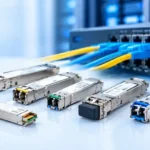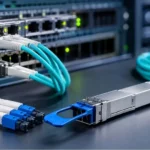




With 400G and 800G dominating headlines, it is fair to ask whether 100G has been left behind. The short answer: no. 100G is no longer the cutting edge, but it remains a workhorse in many networks. Here is where 100G optical transceivers still earn their place, and how to choose the right module.
The Hype vs. the Reality
AI clusters and hyperscale fabrics are pushing spine links to 400G and beyond. But most data centers are not hyperscale. Enterprise server rooms, colocation facilities, campus networks, and regional service providers run on a mix of speeds, and 100G sits comfortably in the middle of that mix.
Two practical reasons keep it relevant. First, a huge installed base of QSFP28 switch ports already exists. Second, higher-speed ports are often broken out into 100G links, so 100G modules stay in use even as the core speeds up.
Where 100G Still Wins
Leaf-to-spine links. For mid-sized fabrics, 100G uplinks provide ample bandwidth without the cost and power draw of faster optics.
Server and storage access. As servers move from 10G and 25G toward 50G and 100G NICs, 100G links at the edge of the fabric are a natural next step.
Breakout from higher speeds. A 400G port can often be split into multiple 100G connections, letting teams adopt newer switches without replacing every endpoint. Support depends on the specific modules and switch, so always confirm.
Data center interconnect and campus backbones. Longer-reach single-mode 100G modules connect buildings and sites where 400G is not yet justified.
Phased upgrades. Many organizations upgrade in stages. 100G is a sensible bridge between 10G/25G and a future 400G design.
Know Your 100G Flavors
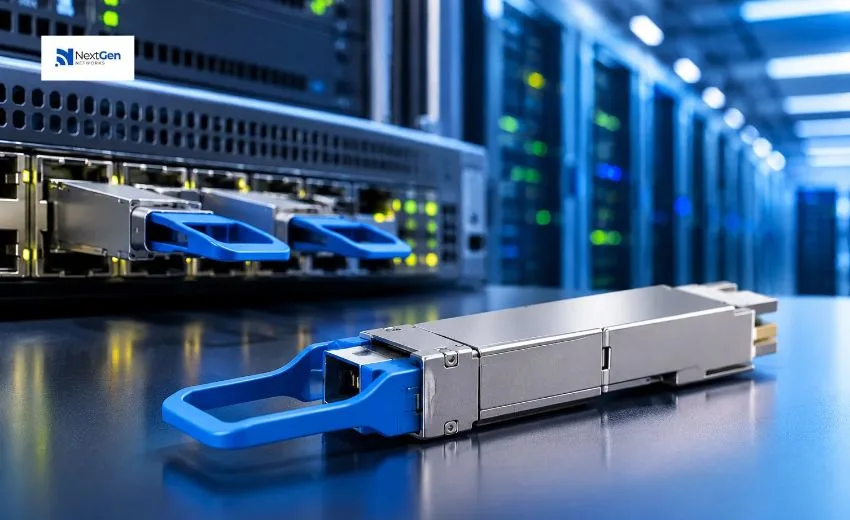
Most 100G links use the QSFP28 form factor. The main variants differ by fiber type and reach:
| Type | Fiber | Typical reach (indicative) | Best for |
| SR4 | Multimode, MPO connector | Tens of meters on OM3/OM4 | In-row and in-hall links |
| CWDM4 | Single-mode, duplex LC | Around 2 km | Campus and mid-range links |
| LR4 | Single-mode, duplex LC | Up to 10 km | Building-to-building, metro |
| PSM4 | Single-mode, parallel fiber | Around 500 m | Data hall links with parallel fiber |
| FR / LR (single-wavelength) | Single-mode, duplex LC | Around 2 km / 10 km | Newer builds, breakout designs |
Reach and specifications vary by manufacturer and exact part number, so check the datasheet for each module before ordering.
Why Cost and Power Matter More Than Speed
Faster is not automatically better. A 400G port costs more to buy, draws more power, and generates more heat. If your traffic fits within 100G links, upgrading everything may add expense without adding value.
Mature 100G products also bring practical benefits: a wide choice of module types, broad familiarity among engineers, and fewer surprises during deployment. Whether it is the right fit depends on your traffic profile, growth plans, and budget.
When 100G Is Not Enough
Be honest about the limits. If you are building AI training clusters, planning heavy east-west traffic growth, or designing a new fabric meant to last many years, 400G or 800G may be the better target. In that case, 100G may still play a supporting role through breakout links and legacy connections.
A Quick Selection Checklist
Before choosing 100G modules, confirm:
- Distance: How far does the link run?
- Fiber: Single-mode or multimode, and what grade?
- Connector: MPO for parallel fiber, or duplex LC?
- Form factor: QSFP28 or another supported type?
- Device compatibility: Is the module on your switch’s supported list, and does your software version accept it?
- Breakout needs: Will the port split from a higher speed?
- Temperature and power: Does your environment require specific ratings?
A matching speed and connector alone do not guarantee compatibility.
Getting 100G Right: Sourcing Support
NextGen Networks supplies optical transceivers and networking hardware, with product listings across 1G to 800G. On its site, the Cisco listings include QSFP-100G-FR-S and QSFP-100G-LR-S, the Arista listings include a range of QSFP-100G part numbers, and the Ruckus listings include E100G-QSFP28 models. Exact specifications, availability, and compatibility vary by part and platform, so confirm details before ordering.
The Verdict
Are 100G optics still relevant in 2026? For many data centers, yes. They deliver proven performance at a sensible cost, and they stay useful even in networks moving toward faster speeds. The right answer depends on your traffic, fiber, equipment, and growth plans, not on the biggest number on the spec sheet.
Planning an upgrade or expansion? Contact NextGen Networks and share your switch model, distance, fiber type, and quantity, and the team can help you identify suitable options among 100G optical transceivers and other modules.