




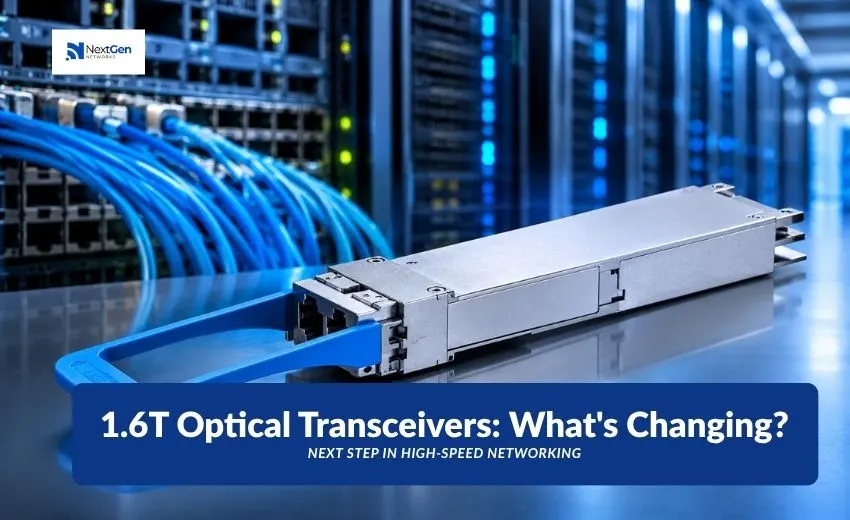
AI training clusters are pushing data center networks harder than any workload before them. Switch chips now move 102.4 Tbps, GPU fabrics span tens of thousands of nodes, and the optics that connect them have to keep up. That is why 1.6T optical transceivers have moved from lab demos to early production in 2026. They double the bandwidth of 800G modules, but the bigger story is how they do it, and what that means for your power budget, cabling and procurement.
Key Takeaways
- A 1.6T optical transceiver delivers 1.6 Terabits per second through one pluggable module, typically using eight 200G PAM4 lanes.
- The main change is lane speed: 200G per lane replaces the 100G per lane used in most 800G modules.
- Power and heat are the biggest design challenges. DSP-based 1.6T modules typically draw roughly 25–30 W, while linear-drive (LPO) designs target around 10 W.
- OSFP224 (also called OSFP1600), OSFP-XD and QSFP-DD1600 are the main form factors, and they are not interchangeable.
- Volume is ramping in 2026, but supply of 200G-per-lane lasers and switch platform readiness will set the pace.
What Is a 1.6T Optical Transceiver?
A 1.6T optical transceiver is a pluggable module that sends and receives 1,600 Gb/s over fiber. Most designs reach that figure with eight electrical and optical lanes running at 200 Gb/s using PAM4 modulation. Common variants include DR8 (parallel single-mode fiber, up to about 500 m), 2×DR4, and 2×FR4, which uses duplex LC connectors and fewer fibers.
The target is clear: connect leaf and spine switches, and scale-out GPU fabrics, without doubling the number of ports and cables.
5 Things That Are Changing With 1.6T
1. The Lane Rate Doubles to 200G
Every earlier speed jump in pluggable optics came from raising the lane rate or adding lanes. 1.6T does both of the hard things at once: it keeps eight lanes and moves each from 100G to 200G PAM4. Signal integrity gets much tighter. PCB traces, connectors and host boards all have to handle higher symbol rates, which is why the host switch platform matters as much as the module.
2. New Form Factors, New Compatibility Questions
OSFP224 achieves 1.6T with eight 200G lanes and stays mechanically compatible with existing 400G and 800G OSFP cages. OSFP-XD reaches the same speed with sixteen 100G lanes on a different electrical lineage. QSFP-DD1600 extends the QSFP-DD family for operators who want backward compatibility and high port density.
The practical lesson: a 1.6T OSFP224 module is not a 1.6T OSFP-XD module. Confirm the exact form factor and host electrical interface before ordering.
3. Power and Cooling Take Center Stage
At 800G, modules commonly draw around 14–20 W. At 1.6T, DSP-based modules can reach 25–30 W or more, which strains switch cooling and rack power. Three approaches are emerging:
- DSP-based (retimed) modules: the mature, most widely deployed option.
- LPO (Linear Pluggable Optics): removes the DSP from the module, cutting power and latency. One vendor data sheet lists a 1.6T DR8 LPO module under 10 W with up to 500 m reach.
- CPO (Co-Packaged Optics): places the optical engine beside the switch ASIC to shorten electrical paths. It is advancing toward industrialization but is not a drop-in replacement for pluggables.
LPO is not a universal swap. It depends on host SerDes quality and careful interoperability testing, so many production clusters will keep DSP-based 1.6T modules as the default through 2026 and 2027.
4. Standards Are Catching Up
IEEE P802.3dj defines 200 Gb/s-per-lane electrical and optical interfaces for 200GbE, 400GbE, 800GbE and 1.6TbE. Management features such as CMIS and VDM (Versatile Diagnostic Monitoring) add per-lane quality data, which helps when troubleshooting 200G PAM4 links.
5. Supply and Switch Readiness Set the Pace
Initial shipments of 1.6T modules began in 2026, and DSP makers have started volume shipments of 200G-per-lane parts. Analysts project 800G-and-above transceiver shipments could grow from roughly 24 million units in 2025 to about 63 million in 2026. Still, market research points to 200G-per-lane laser supply as a gating factor, and demand rises sharply only as 102.4T switch platforms reach large-scale production. Looking ahead, early work on 400G per lane was already showing at OFC 2026.
800G vs 1.6T at a Glance
| Feature | 800G | 1.6T |
| Lane configuration | 8 × 100G PAM4 | 8 × 200G PAM4 |
| Typical DSP module power | ~14–20 W | ~25–30 W |
| Common form factors | OSFP, QSFP-DD800 | OSFP224, OSFP-XD, QSFP-DD1600 |
| Switch ASIC pairing | 51.2T | 102.4T |
| Common variants | DR8, 2×FR4, SR8 | DR8, 2×DR4, 2×FR4, LPO/CPO variants |
| Standards | IEEE 802.3df | IEEE P802.3dj |
Who Should Move to 1.6T Now?
1.6T makes the strongest case in large AI clusters where 800G port counts would create unmanageable fabric complexity, and for operators whose switches already support 200G-per-lane interfaces. If your network runs on 400G or 800G today, you do not need to rush. A 1.6T module only delivers its full value when the switch, cabling and cooling are ready for it.
A Practical Planning Checklist
- Check host compatibility. Confirm the switch supports 200G-per-lane electrical signaling and the exact form factor.
- Match reach to variant. Choose DR8 for short in-building links, 2×FR4 where fiber is scarce.
- Review cabling. DR8 relies on parallel fiber, while FR4 uses duplex LC. Audit your connector inventory.
- Model power and thermals. Calculate per-rack watts before deployment, not after.
- Plan the overlap. 400G, 800G and 1.6T will coexist for years, so keep a migration path across generations.
Working with an optical networking supplier such as NextGen Networks helps you compare transceiver options across speeds and confirm compatibility with your switching platform before you commit.
Frequently Asked Questions
What is a 1.6T optical transceiver?
It is a pluggable fiber optic module that transmits 1.6 Tb/s, usually over eight 200G PAM4 lanes, used mainly in AI and hyperscale data centers.
What is the difference between 800G and 1.6T optical transceivers?
1.6T doubles the data rate by moving from 100G to 200G per lane. It also draws more power with DSP-based designs and needs switch platforms built for 200G-per-lane signaling.
Which form factors support 1.6T?
OSFP224 (OSFP1600), OSFP-XD and QSFP-DD1600. They differ in lane count, thermal headroom and backward compatibility.
What is LPO in 1.6T optics?
Linear Pluggable Optics remove the DSP from the module, lowering power and latency. It suits short-reach links where the host switch provides strong signal processing.
Is it too early to adopt 1.6T?
Early shipments have started, but supply and switch readiness are still ramping. Most operators will run 800G and 1.6T side by side during the transition.
Final Thoughts
1.6T optical transceivers are more than a faster port. They bring 200G-per-lane signaling, new form factors, and a serious focus on power and cooling. Plan around your switch roadmap, verify compatibility early, and stage your upgrade in step with your AI workloads.
Need help sourcing or comparing optical transceivers for your network? Contact NextGen Networks today to discuss your requirements, or explore the product range at NextGen Networks.