



Choosing the right networking hardware is important when you want stable, fast, and reliable data communication. An optical transceiver is one of the key components used in network switches, routers, servers, and data center equipment to transmit and receive data over fiber optic cables. However, selecting the correct module is not simply about choosing the highest speed or the lowest price. Compatibility, transmission distance, fiber type, wavelength, connector type, and equipment requirements all need to be considered before purchasing.
At NextGen Networks, we help businesses, IT teams, system integrators, and network professionals find suitable transceiver modules for their networking requirements. Whether you are upgrading an existing network or building a new infrastructure, understanding the important specifications can help you make a confident buying decision.
Understand Your Network Requirements First
Before purchasing a module, start by identifying what you need the transceiver to do. Consider the network speed, required transmission distance, type of fiber cable, and networking equipment where the module will be installed.
Common speed options include 1G, 10G, 25G, 40G, 100G, 200G, and 400G, depending on the networking environment. A small enterprise network may require 1G or 10G connectivity, while data centers and high-performance environments may require 100G or higher speeds.
Knowing your current requirements also helps you avoid buying a module that is unnecessarily expensive or unsuitable for your equipment.
Check Switch and Router Compatibility
Compatibility should be one of your first purchasing considerations. Different manufacturers use specific module formats and compatibility requirements. A module designed for one networking platform may not automatically work with another.
Before placing an order, check the exact model number of your switch, router, server, or other networking device. You should also verify the supported transceiver type and interface.
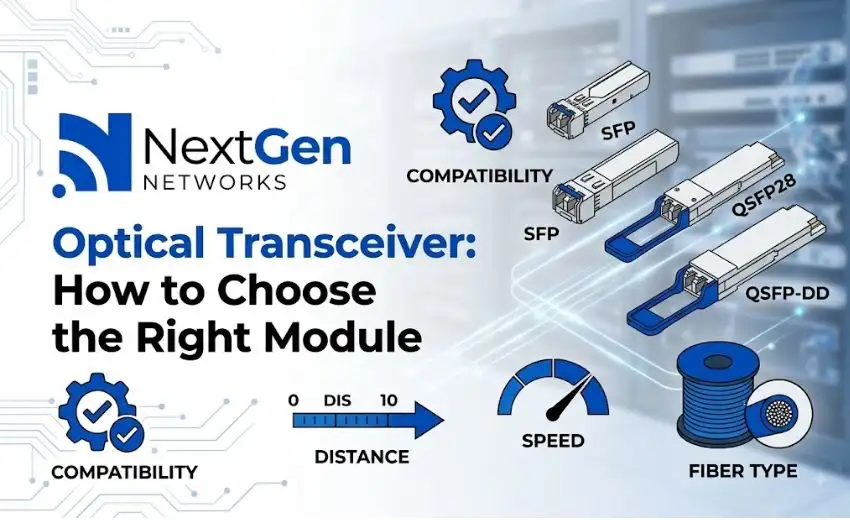
For example, depending on your equipment, you may need an SFP, SFP+, SFP28, QSFP+, QSFP28, or QSFP-DD module. Selecting the correct form factor ensures that the module physically fits and communicates properly with your network hardware.
If you are unsure about compatibility, provide your equipment model to the seller before purchasing. At NextGen Networks, our product range covers modules from various established networking brands, allowing buyers to select solutions according to their existing infrastructure.
Select the Correct Transmission Speed
Network speed directly affects the type of module you need. SFP modules are commonly used for lower-speed connectivity, while SFP+ and SFP28 are frequently selected for 10G and 25G applications.
For higher-performance networks, QSFP+ and QSFP28 modules can support 40G and 100G connectivity respectively, while newer high-speed environments can use modules designed for 200G or 400G applications.
When choosing a module, make sure its speed matches the capabilities of your network equipment. Purchasing a higher-speed module does not necessarily improve performance if the connected switch or router does not support that speed.
Consider the Required Transmission Distance
Transmission distance is another important specification. Different modules are designed for different network ranges.
For short-distance connections inside server rooms or data centers, short-range modules may be sufficient. For longer connections between buildings, data centers, or network locations, long-range modules may be more appropriate.
Typical module categories include short-range, intermediate-range, and long-range solutions. The actual distance supported depends on the module specification, wavelength, fiber type, and network conditions.
Always compare the manufacturer’s stated transmission distance with the actual distance between your networking devices. Choosing a module with insufficient reach can result in unreliable connectivity.
Choose the Right Fiber Type
Fiber compatibility is essential when purchasing a transceiver. The two primary fiber categories are single-mode fiber and multimode fiber.
Single-mode fiber is generally used for longer-distance transmission and telecommunications or large-scale network environments. Multimode fiber is commonly used for shorter-distance applications, particularly within data centers and enterprise environments.
Using a module designed for the wrong fiber type can lead to connectivity problems. Therefore, check your existing fiber infrastructure before selecting the module.
Check the Wavelength
Optical wavelength determines how the module transmits signals through the fiber. Common wavelengths include 850 nm, 1310 nm, and 1550 nm, depending on the module design and application.
For example, many multimode short-distance modules use 850 nm wavelengths, while longer-distance single-mode applications may use 1310 nm or 1550 nm solutions.
The wavelength should be compatible with the fiber and the corresponding transceiver at the other end of the connection. If you are replacing an existing module, checking the specifications of the current unit can make the selection process easier.
Pay Attention to Connector Type
Connector type is another detail buyers should verify before ordering. LC connectors are widely used with many modern transceiver modules, while other applications may use different connector configurations.
For higher-density modules, the connector arrangement can vary significantly. Always compare the connector specification with the fiber patch cable you already have.
This small detail can prevent installation problems and unnecessary replacement costs.
Decide Between Single-Fiber and Dual-Fiber Options
Some transceivers use two fiber strands—one for transmitting and one for receiving. Other solutions use bidirectional technology, allowing transmission and reception over a single fiber using different wavelengths.
Your existing fiber infrastructure determines which option is appropriate. If you are working with a single-fiber installation, a compatible BiDi module may be required.
When purchasing, check both the transmission and receiving wavelength specifications to ensure that the modules at each end are designed to work together.
Consider Brand and Compatibility Requirements
Brand compatibility can be particularly important in enterprise networking environments. Organizations may use equipment from manufacturers such as Cisco, Juniper, Aruba, Arista, Fortinet, or other networking brands.
If your equipment requires a specific branded or compatible module, confirm the exact part number before ordering. A reliable supplier should be able to provide specifications and compatibility information to help you select the appropriate product.
At NextGen Networks, buyers can explore optical networking products from different brands and choose modules based on their equipment, performance requirements, and deployment environment.
Compare Quality, Warranty, and Support
Price is important, but it should not be the only factor when buying networking modules. A low-cost product may not always provide the reliability required for business-critical connectivity.
Compare product specifications, manufacturing quality, compatibility, warranty terms, and supplier support. If the module will be installed in a critical network, dependable performance is especially important.
It is also useful to purchase from a supplier that can assist with product selection before you place the order. This can reduce the risk of purchasing an incompatible module.
Make the Right Purchase Decision
Selecting the right module becomes much easier when you evaluate your requirements systematically. Start with the equipment model and required speed, then check the form factor, transmission distance, fiber type, wavelength, connector, and compatibility requirements.
Do not choose a product based only on appearance or price. The correct module should work with your existing infrastructure and provide the performance and reach required for your application.
If you are looking to purchase an Optical Transceiver, review the technical specifications carefully and confirm compatibility before ordering. NextGen Networks offers networking connectivity products for businesses and network professionals looking for dependable solutions across different applications.
Whether you need modules for an enterprise network, server environment, data center, or fiber connectivity upgrade, selecting the correct specification from the beginning can help ensure smoother installation, reliable communication, and long-term network performance.