



As data traffic continues to grow across cloud platforms, data centers, enterprise networks, and high-performance computing environments, traditional networking speeds are increasingly being pushed to their limits. 400G optical transceivers are designed to address this demand by providing significantly higher bandwidth while maintaining the compact, pluggable architecture required by modern networking equipment.
Finisar has a strong presence in the optical networking market, with its product portfolio covering multiple generations of optical transceivers. For organizations planning high-bandwidth infrastructure, understanding 400G technologies, form factors, transmission standards, and application requirements is important before selecting the right optical module.
What Are 400G Optical Transceivers?
A 400G optical transceiver is a networking module designed to transmit and receive data at up to 400 gigabits per second over optical fiber. Unlike copper-based connections, optical transceivers use light signals to move large volumes of data across network infrastructure.
400G modules are particularly useful in modern data centers, cloud infrastructure, AI and high-performance computing environments, service-provider networks, and high-capacity enterprise backbones.
The move from 100G and 200G toward 400G is not simply about increasing speed. It also involves improvements in port density, power efficiency, fiber utilization, and network scalability.
Finisar’s Role in High-Speed Optical Connectivity
Finisar is a recognized name in optical communication technology, and its transceiver portfolio includes solutions across different data rates and form factors. The product listings available through NextGen Networks include Finisar/II-VI optical products ranging from SFP and SFP+ modules to 100G, 200G, and 400G solutions.
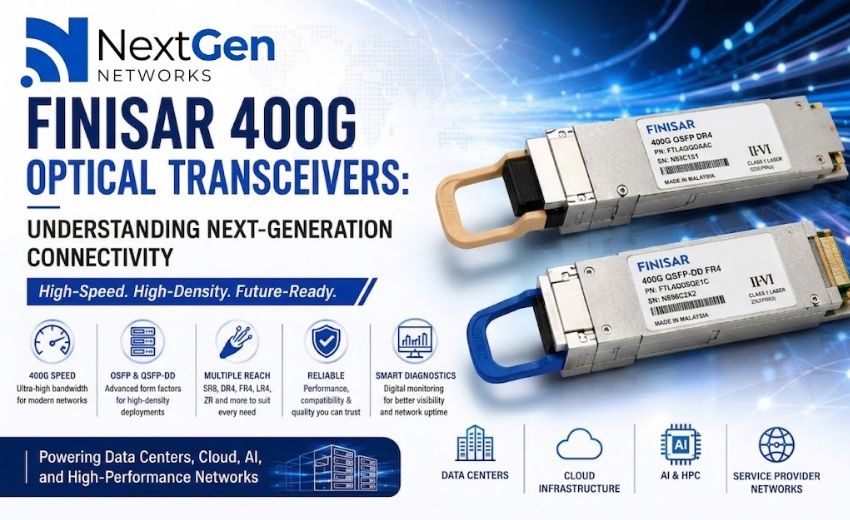
For example, the available product portfolio includes 400G OSFP and QSFP-DD families, with models such as OSFP-400G-DR4, OSFP-400G-FR4, OSFP-400G-SR8, OSFP-400G-ZR, QDD-400G-DR4, QDD-400G-FR4, QDD-400G-LR4, and other variants.
This variety is important because not every 400G deployment has the same distance, fiber, switch, or network architecture requirements.
Understanding 400G Form Factors
Two important form-factor families used for 400G connectivity are OSFP and QSFP-DD.
OSFP, or Octal Small Form-factor Pluggable, is designed for high-density, high-speed networking applications. Its larger physical design can provide thermal and electrical advantages for demanding 400G and higher-speed applications.
QSFP-DD, or Quad Small Form-factor Pluggable Double Density, expands the established QSFP architecture to support higher bandwidth while maintaining a compact footprint. It is especially relevant for high-density switches and data-center platforms.
When selecting a module, network administrators should always verify that the transceiver form factor matches the host device. Physical compatibility alone is not enough; the switch, firmware, port configuration, optical specification, and supported standards should also be considered.
Different 400G Optical Options
400G transceivers are available in different optical configurations depending on the required transmission distance and network environment.
For short-distance data-center connections, multimode or short-reach solutions can be appropriate. Longer-distance deployments may require single-mode fiber and optics designed for extended reach.
Common product categories include:
- 400G DR4: Designed for high-speed connections using parallel optical lanes.
- 400G FR4: Intended for longer-reach applications than typical short-reach solutions.
- 400G LR4: Suitable for extended single-mode fiber connectivity.
- 400G SR8: Focused on short-reach, high-density data-center applications.
- 400G ZR: Designed for substantially longer-distance optical connectivity.
The exact specifications, supported distance, fiber type, connector, wavelength configuration, and host compatibility vary by model. Buyers should therefore evaluate the manufacturer’s datasheet rather than selecting a module based only on its 400G speed rating.
Why 400G Matters for Modern Networks
One of the biggest advantages of 400G connectivity is the ability to move more data through fewer physical ports. This can help network operators increase capacity without proportionally increasing equipment footprint.
For example, organizations handling AI workloads, virtualization, large databases, video platforms, cloud applications, and high-volume storage traffic may require substantial east-west bandwidth inside data centers.
A finisar sfp transceiver module is typically associated with lower-speed SFP-family applications, while 400G products use more advanced high-density form factors such as OSFP and QSFP-DD. Understanding this distinction helps buyers avoid choosing a module based solely on the familiar “SFP” terminology.
Applications of 400G Optical Transceivers
400G optical modules can support a variety of modern networking scenarios.
Data Centers
Large data centers require high-capacity connections between servers, switches, storage systems, and aggregation layers. 400G optics can provide high-bandwidth links while supporting dense switch configurations.
Cloud Infrastructure
Cloud providers handle enormous quantities of data across distributed computing infrastructure. Higher-speed optical links can help create scalable network architectures capable of supporting increasing application traffic.
AI and High-Performance Computing
AI training and high-performance computing can generate significant traffic between compute nodes and networking systems. High-speed optical connectivity is therefore becoming increasingly important for reducing network bottlenecks.
Enterprise Networks
Large enterprises upgrading their core or data-center infrastructure may use 400G connectivity where bandwidth requirements justify the investment. It can also provide additional capacity for future network growth.
Choosing the Right 400G Module
Selecting a 400G optical transceiver should involve more than checking the transmission speed. Consider the following factors:
Compatibility: Confirm that the module is supported by the intended switch, router, server, or network adapter.
Fiber Type: Determine whether the deployment uses multimode or single-mode fiber.
Transmission Distance: Choose the optical specification based on the actual link distance.
Form Factor: Verify whether the equipment requires OSFP, QSFP-DD, or another compatible format.
Connector Type: Check the required optical connector and lane configuration.
Power and Thermal Requirements: High-speed optics can generate significant heat, making power consumption and airflow important considerations.
Diagnostics: Digital monitoring capabilities can help administrators track module performance and identify potential problems.
Why Work with a Product-Focused Supplier?
High-speed networking equipment needs careful product matching. A module that appears suitable based on speed alone may not work correctly with a particular switch or network architecture.
NextGen Networks provides access to a broad range of networking hardware and optical products, including Finisar, Cisco, Aruba, Arista, Fortinet, Juniper, NVIDIA Mellanox, and other brands. Its product listings include optical modules, switches, cables, and related networking hardware.
When purchasing, customers should provide the exact switch or device model, required transmission distance, fiber type, desired form factor, and application requirements. This makes it easier to identify a suitable optical solution rather than selecting a module solely from its headline speed.
The Future of High-Speed Optical Connectivity
The networking industry is moving rapidly toward 400G and beyond as cloud computing, AI, streaming, virtualization, and data-intensive applications continue to expand. 400G optical transceivers represent an important step in this progression, offering the bandwidth and density required by modern infrastructure.
At the same time, 400G should be viewed as part of a broader optical roadmap. Organizations planning new deployments should consider not only current bandwidth requirements but also future scalability, equipment compatibility, fiber infrastructure, power consumption, and operational needs.
For buyers researching a finisar sfp transceiver module, it is equally important to understand the difference between conventional SFP-family products and next-generation 400G modules. The right choice depends on the network architecture, supported interface, optical reach, and application—not simply the brand or data rate.
Conclusion
Finisar 400G optical transceivers provide an important option for organizations moving toward higher-capacity networking. With different form factors and optical configurations available, 400G solutions can support data centers, cloud environments, enterprise networks, and high-performance computing applications.
Whether upgrading an existing infrastructure or designing a new high-speed network, careful evaluation of compatibility, reach, fiber type, form factor, and power requirements is essential. A finisar sfp transceiver module may be suitable for certain lower-speed applications, while 400G OSFP or QSFP-DD solutions can address substantially higher bandwidth requirements.
For businesses evaluating optical networking products, NextGen Networks offers a product-focused approach to sourcing transceivers and related networking hardware. Comparing the exact model specifications with the requirements of your equipment is the best way to build a reliable, scalable, and future-ready connectivity solution.