



Our previous guide covered 10 Aruba transceivers, highlighting their key features, uses, and differences. Now, let’s take a closer look at one of the most widely used form factors in this lineup: SFP transceivers.
SFP modules are popular in business networks because they offer a flexible way to connect switches, servers, and other networking devices. However, not every SFP module works in the same way. Speed, fiber type, wavelength, transmission distance, and compatibility can all vary between modules.
What Are Aruba SFP Transceivers?
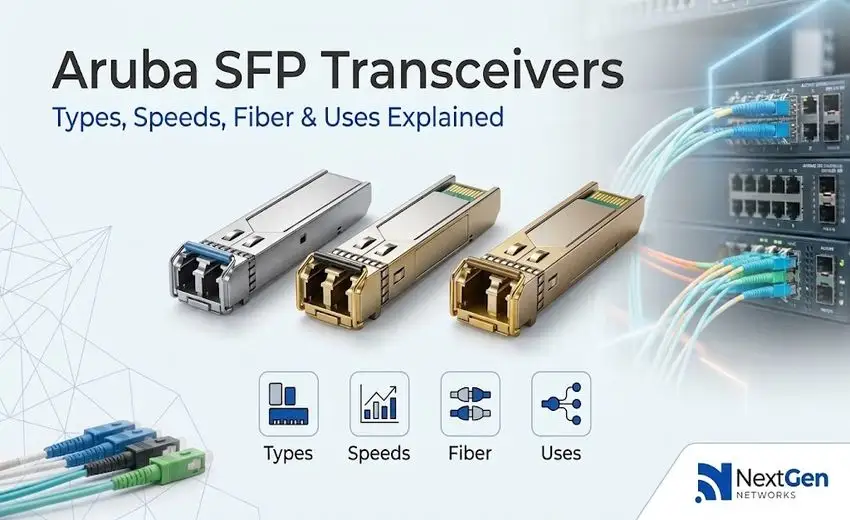
SFP stands for Small Form-factor Pluggable. It is a compact, removable module that fits into a compatible port on a network device. Instead of using a fixed connection, businesses can select an appropriate transceiver according to their network requirements.
Aruba Optical Transceivers in the SFP category are commonly used for Gigabit Ethernet connectivity. They can support different fiber types and distances, making them suitable for a wide range of network environments.
Their removable design is also useful when businesses need to upgrade or change network connections without replacing the entire switch.
Main Types of Aruba SFP Transceivers
SFP modules can differ based on their fiber type, wavelength, and transmission range. Understanding these differences makes it easier to select suitable Aruba Optical Transceivers for a specific network.
SX SFP Transceivers
SX modules are mainly designed for shorter-distance connections over multimode fiber. They commonly use an 850nm wavelength and are suitable for many local network applications.
SX modules can be used for:
- Server room connections
- Short switch-to-switch links
- Campus networks
- Data center connections
For networks using multimode fiber, SX Aruba Optical Transceivers can be a practical choice for short-range Gigabit connectivity.
LX SFP Transceivers
LX modules are designed for longer connections than typical SX modules. They are commonly used with single-mode fiber and operate around the 1310nm wavelength.
Typical applications include:
- Building-to-building links
- Enterprise fiber backbones
- Campus networks
- Longer switch-to-switch connections
The supported reach depends on the exact module and fiber setup, so specifications should be checked before deployment.
LH SFP Transceivers
LH modules are intended for extended-distance fiber connections. They are generally used with single-mode fiber when a network requires more reach than a standard short-range module can provide.
They can be useful for large campuses, enterprise infrastructure, and long-distance fiber connections.
Understanding SFP Speeds
Speed is one of the first specifications to check when choosing Aruba Optical Transceivers.
Standard SFP modules are commonly used for 1G connectivity, while related form factors support higher network speeds:
- SFP: commonly used for 1G
- SFP+: commonly used for 10G
- SFP28: commonly used for 25G
The module speed should match the capabilities of the network device. Checking the switch port before purchasing can help prevent compatibility issues.
Multimode vs Single-Mode Fiber
Fiber type is another important factor when selecting Aruba Optical Transceivers.
Multimode fiber (MMF) is generally used for shorter connections. It is common in data centers, server rooms, and campus networks.
Single-mode fiber (SMF) is normally selected for longer-distance links. It is often used for enterprise backbones and connections between buildings.
Before ordering a module, check which type of fiber is already installed. The transceiver should be suitable for the existing cabling.
Why Wavelength Matters
Wavelength refers to the optical light used to transmit data through the fiber. Common wavelengths include 850nm, 1310nm, and 1550nm.
The wavelength is related to the module’s fiber type, application, and transmission range. Therefore, it should be checked along with the other specifications when selecting Aruba Optical Transceivers.
Matching the correct wavelength with the network design can help maintain a reliable optical connection.
Where Are Aruba SFP Transceivers Used?
Aruba Optical Transceivers can be used in many business networking environments, including:
- Enterprise networks
- Campus networks
- Data centers
- Fiber backbone connections
- Building-to-building links
- Switch-to-switch connections
- Server-to-switch links
Their modular design also gives businesses more flexibility when expanding their network or changing connection requirements.
How to Choose the Right Aruba SFP Module
Before purchasing Aruba Optical Transceivers, network teams should check a few important specifications.
Speed: Make sure the module supports the required network speed.
Fiber type: Confirm whether the installation uses multimode or single-mode fiber.
Distance: Select a module that supports the required transmission range.
Wavelength: Check that the optical specifications match the planned connection.
Connector: Make sure the connector matches the existing fiber infrastructure.
Compatibility: Confirm that the module is supported by the intended Aruba networking equipment.
These checks can help businesses avoid compatibility problems and select the right module for their network.
Aruba Optical Transceivers for B2B Networking
For businesses managing multiple switches, servers, offices, or data center connections, choosing the right optical modules is important for smooth network deployment.
NextGen Networks provides Aruba Optical Transceivers for businesses looking for networking components based on different speed, fiber, reach, and application requirements.
For larger deployments, businesses can also review their requirements before ordering to make sure the selected modules match their existing infrastructure.
Final Thoughts
Aruba SFP transceivers provide a flexible option for fiber-based network connectivity. The right module depends on several factors rather than the SFP form factor alone.
Speed, fiber type, wavelength, transmission distance, connector, and equipment compatibility should all be considered before purchasing Aruba Optical Transceivers.
For businesses planning a network upgrade, expansion, or new deployment, selecting suitable modules from the start can help reduce compatibility issues and simplify installation.
Need Aruba Optical Transceivers for a business project or bulk requirement? Contact NextGen Networks with your required model, quantity, and network specifications to discuss suitable options for your B2B network deployment.
Frequently Asked Questions
1. What are Aruba SFP transceivers and how do they work?
Aruba SFP transceivers are compact modules that connect compatible network devices over fiber or copper. They convert network signals for data transmission.
2. What is the difference between Aruba SX, LX, and LH SFP transceivers?
SX is mainly for short-distance multimode fiber, LX supports longer-distance links, and LH is designed for extended-distance single-mode fiber connections.
3. Which fiber type is best for Aruba SFP transceivers?
Multimode fiber is generally suitable for shorter links, while single-mode fiber is preferred for longer-distance connections.
4. How do I choose the right Aruba SFP transceiver for my network?
Check the required speed, fiber type, transmission distance, wavelength, connector, and compatibility with your network device.
5. What are Aruba SFP transceivers commonly used for?
They are commonly used for switch-to-switch, server-to-switch, data center, campus, backbone, and building-to-building network connections.