



The QSFP 40G SR4 is still one of the most widely deployed 40G optics in data centers. It is inexpensive, standards-based, and the simplest way to run 40G over multimode fiber or split one 40G port into four 10G connections. Here is what a QSFP 40G SR4 module actually is, how it differs from other 40G optics, and what to check before you order one.
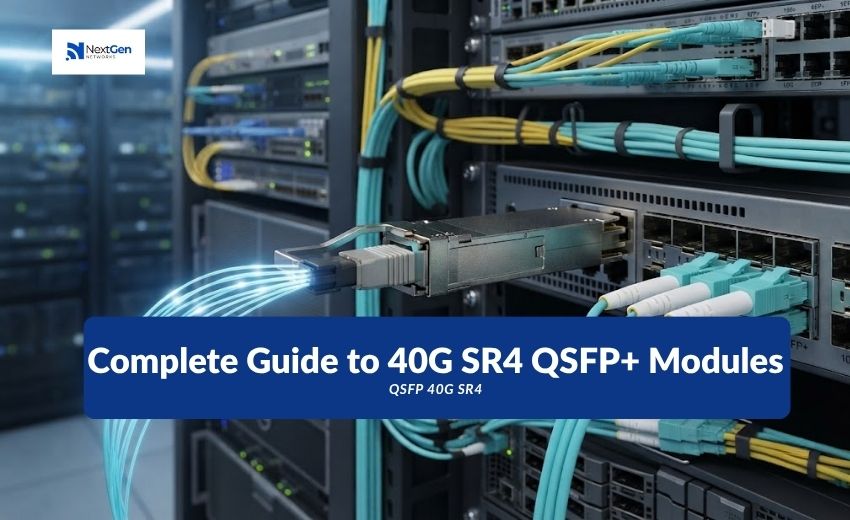
What Is a QSFP 40G SR4 Transceiver?
A QSFP 40G SR4 is a hot-pluggable optical module that delivers 40 Gigabit Ethernet over multimode fiber. The name breaks down like this:
- QSFP (technically QSFP+) is the four-lane, 40G-generation form factor
- 40G is the total data rate
- SR4 means short reach over four parallel lanes
It follows the IEEE 802.3ba 40GBASE-SR4 standard. Inside the module, four 10G lanes transmit and four 10G lanes receive at the same time at 850nm, and together they make up the 40G link. Because the lanes run on separate fibers instead of being multiplexed onto one pair, the design stays simple, low-power, and cost-effective.
How QSFP 40G SR4 Works: Parallel Optics and MPO
Most longer-reach 40G modules combine four wavelengths onto a single fiber pair. The QSFP 40G SR4 does not. It uses parallel optics, which means a multi-fiber MPO/MTP connector instead of the duplex LC connector found on 10G SFP+ and 25G SFP28 modules. Of the 12 fibers in an MPO-12 connector, 8 are active: four to transmit and four to receive.
That design keeps the cost down, but it also means you need the right cabling. A standard LC patch cord will not work with an SR4 module.
QSFP 40G SR4 vs. Other 40G Variants
40GBASE-SR4 (multimode, short reach). Uses 850nm lasers over OM3 or OM4 multimode fiber with an MPO-12 connector. Typical reach is around 100m on OM3 and 150m on OM4. This is the standard choice for in-row and in-building links.
Extended-reach SR4 (CSR4 / eSR4). The same parallel-fiber design with stronger optics, typically reaching 300m on OM3 and 400m on OM4. Useful for longer multimode runs without moving to single-mode. Naming varies by vendor, so confirm the datasheet.
40G BiDi (such as the Cisco QSFP-40/100-SRBD). Runs 40G over a duplex LC multimode pair instead of MPO, which lets you reuse existing 10G fiber. Reach at 40G is typically around 100m on OM3 and 150m on OM4. Some BiDi modules also support 100G on compatible ports, at shorter reach. Check your platform’s supported-optics list.
40GBASE-LR4 (single-mode, long reach). Uses four wavelengths over a single-mode duplex LC pair, with a typical reach of up to 10km. The default choice for links between buildings or beyond multimode limits.
Direct-attach copper (40G DAC) and active optical cables. For very short in-rack or adjacent-rack runs, a DAC or AOC is often simpler and cheaper than a transceiver plus patch cable.
QSFP 40G SR4 Quick Reference
| Type | Fiber | Wavelength | Typical Reach | Connector |
| QSFP 40G SR4 | Multimode | 850nm | 100m (OM3) / 150m (OM4) | MPO-12 |
| 40G CSR4 / eSR4 | Multimode | 850nm | 300m (OM3) / 400m (OM4) | MPO-12 |
| 40G BiDi (SRBD) | Multimode | 850/900nm | 100m (OM3) / 150m (OM4) | Duplex LC |
| 40GBASE-LR4 | Single-mode | 1310nm (4 wavelengths) | 10 km | Duplex LC |
| 40G DAC / AOC | Copper / active optical | n/a | A few meters | Built-in |
Reach figures vary by manufacturer and fiber quality. Always confirm exact numbers against the specific datasheet.
4x10G Breakout With QSFP 40G SR4
One of the main reasons the QSFP 40G SR4 is still widely deployed is breakout. A single 40G SR4 port can split into four independent 10G links using an MPO-to-4x LC fan-out cable, with a 10G SFP+ SR module at each server or switch end.
That is useful when you want to:
- Increase server-facing port density on a top-of-rack switch
- Connect several 10G hosts to one 40G port
- Extend the life of 10G servers without replacing the switch
Two things to check first. The switch port must support breakout mode, which depends on the platform. And not every SR4 module supports 4x10G operation: Cisco’s documentation notes that the standard QSFP-40G-SR4 supports it, while the QSFP-40G-SR4-S does not. If breakout is your plan, confirm the exact part number.
QSFP 40G SR4 Brands at NextGen Networks
NextGen Networks supplies genuine optical transceivers across major networking brands, including Cisco, Finisar, Aruba, Juniper, Arista, Fortinet, and NVIDIA Mellanox. For 40G in particular:
- Cisco QSFP-40G-SR4: the standard 40GBASE-SR4 module for Cisco platforms
- Cisco QSFP-40/100-SRBD: a BiDi option for reusing duplex multimode fiber
- Cisco QSFP-40G-LR4-S: for single-mode links up to 10km
- Cisco QSFP-4X10G-LR-S: for 4x10G single-mode breakout
Matching the part number to your switch’s supported-optics list is the first step. For other brands and part numbers, contact our team and we will confirm compatibility before you order.
QSFP 40G SR4 vs. 100G QSFP28: Should You Upgrade?
The QSFP 40G SR4 remains a solid choice in the right setting, but it is no longer the default for new builds.
Staying on QSFP 40G SR4 makes sense when:
- Your switches only have QSFP+ ports and are not due for replacement
- You rely on 4x10G breakout to serve existing 10G servers
- Your multimode fiber is OM3 or OM4 and your links are within 100 to 150m
- 40G is not your bottleneck, so there is no urgency
Moving to 100G QSFP28 makes sense when:
- You are building a new data center or planning a spine refresh
- You want headroom for 25G server connections (100G breaks out to 4x25G)
- You need higher density per rack unit
Many modern switches support both speeds on the same ports, so you can upgrade the spine to 100G while leaving existing 40G leaf switches in place. If you are planning the server side too, see our guide to 25G SFP28 transceivers.
Buying Considerations
Confirm your fiber type first. QSFP 40G SR4 needs multimode fiber. It will not work over single-mode.
Check your cabling. SR4 uses MPO/MTP-12 connectors. Make sure your trunks, patch cords, and fan-out cables match, including polarity.
Match reach to your fiber grade. OM3 and OM4 give different distances. Do not plan a 150m link on OM3.
Check your platform’s supported-optics list. Exact part-number compatibility varies by switch model and vendor.
Confirm breakout support. If you plan 4x10G, make sure both the module and the switch port support it.
Look for DDM/DOM support. Digital diagnostics let you monitor transmit power, receive power, and temperature, which makes troubleshooting much faster.
Clean your MPO connectors. Dirty end faces are one of the most common causes of intermittent errors on parallel-optic links.
Frequently Asked Questions
What does SR4 stand for in QSFP 40G SR4? SR stands for short reach, and 4 refers to the four parallel 10G lanes that make up the 40G link.
What is the maximum distance of a QSFP 40G SR4 module? Typically around 100m over OM3 and 150m over OM4 multimode fiber. Extended-reach variants can go further.
What cable does a QSFP 40G SR4 use? Multimode fiber with an MPO/MTP-12 connector. A standard LC duplex patch cord will not work.
Can I split one QSFP 40G SR4 port into four 10G links? Yes, using an MPO-to-4x LC breakout cable and four 10G SFP+ SR modules, as long as the module and switch port support breakout mode.
Is QSFP-40G-SR4 the same as QSFP 40G SR4? QSFP-40G-SR4 is Cisco’s part number for a 40GBASE-SR4 module. Other vendors use their own part numbers for the same standard.
Can I use a QSFP 40G SR4 in a 100G QSFP28 port? Many 100G ports support 40G operation, but not all do. Check your switch documentation.
Is 40G obsolete? Not in the installed base. Many networks still run on it, but for new projects 100G is generally the better long-term choice.
Which brands of QSFP 40G SR4 does NextGen Networks supply? We supply Cisco 40G modules including QSFP-40G-SR4, along with other brands. Contact our team to confirm the part number for your platform.
Sourcing QSFP 40G SR4 Transceivers
NextGen Networks supplies genuine optical transceivers across Cisco, Finisar, Aruba, NVIDIA Mellanox, and more, with express shipping across India. If you are unsure which SR4, BiDi, or LR4 module matches your switch and fiber, get in touch and our team will help you confirm before you order. For higher-speed fabrics that 40G links feed into, see our Cisco 400G and 800G optics guide.
Conclusion
The QSFP 40G SR4 is a proven, low-cost, standards-based module that still earns its place in existing leaf-spine networks and 4x10G breakout designs. For new builds, 100G is where the market is heading, but there is no need to replace working 40G infrastructure ahead of schedule. Confirm your fiber type, plan your MPO cabling, and match the part number to your platform, and you will cover almost every buying decision in this category.